
TL;DR: Pipedrive offers the best overall Salesforce alternative for small businesses wanting strong visual pipeline management without enterprise complexity. Zoho CRM provides the most affordable comprehensive feature set, particularly valuable for businesses wanting room to grow into a broader business suite. HubSpot’s free tier remains unbeatable for startups wanting genuine functionality at zero cost. Below, we compare 9 platforms by price, ease of use, and migration considerations.
Executive Summary
Salesforce is built for enterprise scale, and its Starter tier (formerly Essentials) is a deliberately simplified version of a platform designed for far larger, more complex organizations. Many small businesses choosing Salesforce do so for brand recognition rather than genuine fit, ending up with either an underused enterprise tool or mounting costs as they add features to make the platform genuinely useful.
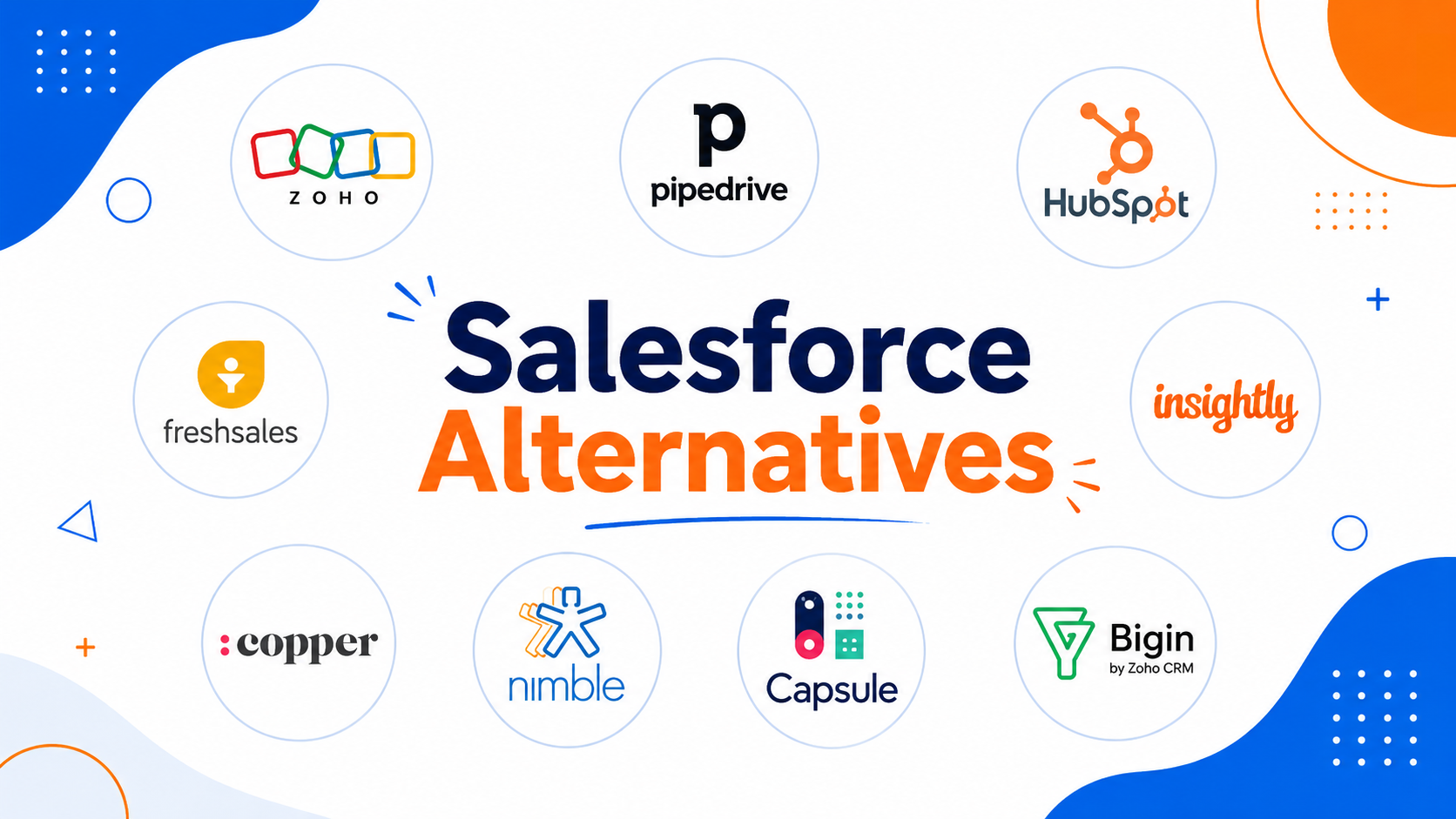
This guide compares the nine strongest Salesforce alternatives specifically suited to small business needs and budgets in 2026.
Who This Guide Is For
- Small businesses currently evaluating Salesforce against more accessible alternatives
- Current Salesforce Starter users frustrated by feature limitations or rising costs
- Startups and growing businesses wanting genuine CRM functionality without enterprise complexity
- Teams that found Salesforce’s learning curve too steep for their needs
Why Small Businesses Look Beyond Salesforce
- Starter tier limitations force costly upgrades to Professional for basic automation needs
- Steeper learning curve even at entry tiers compared to SMB-focused alternatives
- Add-on costs accumulate quickly for features bundled natively into competitor platforms
- Implementation often requires consultant support, adding cost most small businesses want to avoid
- Overkill for straightforward sales processes that don’t need Salesforce’s enterprise-level customization depth
Quick Comparison Table
| Platform | Starting Price | Free Tier | Best For |
|---|---|---|---|
| Pipedrive | $14/user/month | No | Visual pipeline simplicity |
| Zoho CRM | $14/user/month | Yes (3 users) | Affordable comprehensive features |
| HubSpot | Free–$20/user/month | Yes (unlimited users) | Best free tier |
| Freshsales | $9/user/month | Yes (3 users) | AI-assisted scoring on a budget |
| Insightly | $29/user/month | Yes (2 users) | Project management crossover |
| Copper | $25/user/month | No | Google Workspace integration |
| Nimble | $24.90/user/month | No | Social media-integrated relationship CRM |
| Capsule | $18/user/month | Yes (2 users) | Simple contact management |
| Zoho Bigin | $7/user/month | Yes (1 user) | Solo founders, pipeline simplicity |
Pipedrive — Best Visual Pipeline Simplicity
Pipedrive was built specifically around intuitive visual pipeline management, making it the most natural fit for small sales teams transitioning away from Salesforce’s complexity.
Strengths:
- Highly intuitive drag-and-drop pipeline far simpler than Salesforce’s interface
- Strong automation for repetitive tasks at accessible pricing
- Affordable scaling as your team grows, without Salesforce’s steep tier jumps
Limitations:
- Less customizable for genuinely complex, multi-department sales processes
- Marketing automation features are more limited than HubSpot
Pricing: Starts at $14/user/month.
Best for: Small sales teams wanting the simplest possible transition from Salesforce’s complexity.
(See our Best Sales Pipeline Software guide for further comparison.)
Zoho CRM — Best Affordable Comprehensive Features
Zoho CRM delivers functionality comparable to Salesforce’s mid-tier offerings at a fraction of the cost, with a free tier for very small teams.
Strengths:
- Genuinely comprehensive feature set at dramatically lower price points than Salesforce
- Zia AI assistant provides predictive scoring without enterprise-level pricing
- Broader Zoho ecosystem (Books, Desk, Campaigns) integrates affordably as you grow
Limitations:
- Interface feels less polished than Salesforce or Pipedrive
- Smaller third-party integration marketplace than Salesforce’s AppExchange
Pricing: Free for up to 3 users; Standard tier from $14/user/month.
Best for: Small businesses wanting comprehensive functionality without Salesforce’s enterprise pricing.
(See our Zoho CRM vs Salesforce Essentials comparison for detailed analysis.)
HubSpot — Best Free Tier
HubSpot’s free CRM offers genuinely usable functionality with unlimited users, making it the strongest zero-cost starting point among Salesforce alternatives.
Strengths:
- Unlimited free users, a rare feature among competitors
- Clear upgrade path into deeper marketing and sales automation as you grow
- Strong documentation and onboarding resources for non-technical teams
Limitations:
- Advanced automation and reporting require paid Hub upgrades
- Real automation depth requires Professional tier, a significant price jump
Pricing: Free indefinitely; paid Hubs start at $20/user/month.
Best for: Startups and very small businesses wanting genuine functionality at zero starting cost.
(See our Free CRM for Startups guide for further free-tier comparison.)
Freshsales — Best AI-Assisted Budget Option
Freshsales bundles AI-powered lead scoring into one of the most affordable full-featured platforms in this comparison.
Strengths:
- AI-based deal scoring highlights priority leads without premium pricing
- Built-in phone and email functionality within the platform
- Clean, modern interface with minimal learning curve
Limitations:
- Smaller third-party integration ecosystem than Salesforce or Zoho
- Advanced automation requires higher-tier plans
Pricing: Starts at $9/user/month.
Best for: Budget-conscious small teams wanting AI-assisted prioritization.
Insightly — Best Project Management Crossover
Insightly bundles basic project management alongside CRM, useful for small businesses managing both sales and client delivery.
Strengths:
- Combines CRM with basic project tracking for service delivery
- Reasonable free tier for very small teams
- Good for businesses managing both sales pipeline and post-sale project work
Limitations:
- Interface feels less modern than newer competitors
- Limited to 2 free users
Pricing: Free for 2 users; paid plans start around $29/user/month.
Best for: Service-based small businesses wanting project tracking alongside CRM.
Copper — Best for Google Workspace Integration
Copper integrates deeply with Gmail and Google Workspace, automatically capturing activity for teams already embedded in that ecosystem.
Strengths:
- Deep native Google Workspace integration reduces manual data entry
- Automatic activity capture from email and calendar
- Clean, simple interface requiring minimal training
Limitations:
- Less valuable for teams not using Google Workspace
- Reporting is less advanced than Salesforce or Zoho
Pricing: Starts at $25/user/month.
Best for: Small teams fully embedded in Google Workspace wanting automatic activity capture.
Nimble — Best Social Media-Integrated Relationship CRM
Nimble emphasizes relationship building through social media integration, pulling contact context from LinkedIn and other platforms.
Strengths:
- Social media integration provides richer contact context automatically
- Good for relationship-focused sales rather than high-volume transactional selling
- Browser extension simplifies capturing contacts while browsing
Limitations:
- Less suited to complex, high-volume sales pipeline management
- Smaller feature set for advanced automation compared to Pipedrive or Zoho
Pricing: Starts at $24.90/user/month.
Best for: Small businesses prioritizing relationship-building and social context over transactional pipeline volume.
Capsule — Best Simple Contact Management
Capsule focuses on straightforward contact and relationship management without the complexity of a full sales platform.
Strengths:
- Clean, simple interface with minimal learning curve
- Good for relationship-focused businesses beyond pure transactional sales
- Reasonable free tier for very small teams
Limitations:
- Limited to 250 contacts on the free tier
- Fewer advanced automation features than larger competitors
Pricing: Free for 2 users; paid plans start around $18/user/month.
Best for: Small businesses wanting simple relationship tracking without complex pipeline automation.
Zoho Bigin — Best for Solo Founders
Zoho’s simplified, pipeline-focused CRM strips away complexity for solo founders and very small teams.
Strengths:
- Extremely simple, fast setup focused purely on pipeline tracking
- Very affordable, even on paid tiers
- Minimal learning curve compared to any Salesforce tier
Limitations:
- Limited to 500 contacts on the free tier
- Lacks broader CRM features available in full Zoho CRM
Pricing: Free for 1 user; paid plans start at $7/user/month.
Best for: Solo founders wanting bare-bones pipeline tracking without complexity.
How to Choose the Right Salesforce Alternative
If you want the simplest visual pipeline transition: Pipedrive.
If you want comprehensive features at low cost: Zoho CRM.
If you want the strongest free tier: HubSpot.
If budget is your absolute top priority: Freshsales or Zoho Bigin.
If you manage both sales and project delivery: Insightly.
If you live in Google Workspace: Copper.
If relationship-building and social context matter most: Nimble.
Migration Checklist: Switching From Salesforce
- Export your full contact, account, and opportunity data before canceling your Salesforce subscription
- Document your current automation workflows so you can rebuild equivalent logic in your new platform
- Identify which AppExchange integrations are truly essential versus nice-to-have, since most alternatives have smaller integration ecosystems
- Run a test migration with sample data before migrating your full dataset
- Train your team on the new interface before fully cutting over, since even simpler platforms require some adjustment period
Frequently Asked Questions
Why do small businesses choose Salesforce in the first place if alternatives are better suited?
Often brand recognition, investor or partner expectations, or anticipated future growth drive the initial choice, even when current needs don’t justify the complexity and cost.
Which Salesforce alternative is most similar in feature depth?
Zoho CRM offers the closest feature parity to Salesforce’s mid-tier offerings, particularly with its Enterprise tier and Zia AI capabilities, at a fraction of the cost.
Can I migrate my Salesforce data to a new CRM without losing information?
Yes, most platforms support CSV import for contacts, accounts, and opportunities, though some metadata (custom field configurations, complex automation logic) may require manual reconstruction.
Is switching away from Salesforce risky if we eventually need to scale significantly?
Most alternatives, including Zoho and HubSpot, scale reasonably well into the mid-market range. True enterprise-scale complexity is where Salesforce’s ceiling becomes genuinely differentiating, which most small businesses won’t reach for years, if ever.
Which alternative is best if my team found Salesforce’s learning curve too steep?
Pipedrive and Zoho Bigin both offer significantly gentler learning curves, with intuitive visual interfaces that most teams master within days rather than weeks.
How much can a small business actually save by switching from Salesforce?
Often significantly — moving from Salesforce Professional ($80/user/month) to Zoho CRM Professional ($23/user/month) for a 10-person team saves over $6,800 annually on subscription costs alone, before factoring in reduced implementation complexity.
Do these alternatives integrate with the same third-party tools as Salesforce?
Coverage varies — major tools (email, calendar, popular accounting software) are typically supported across all alternatives, but Salesforce’s AppExchange offers a far larger selection of niche integrations than any single alternative.
Is it worth trying a free tier before committing to a paid alternative?
Yes, HubSpot, Zoho CRM, Freshsales, Insightly, and Capsule all offer free tiers sufficient for testing genuine fit before any financial commitment, significantly reducing the risk of choosing the wrong platform.
Final Verdict
For most small businesses currently on or considering Salesforce, Pipedrive offers the most natural transition toward genuine simplicity without sacrificing core pipeline functionality. Businesses wanting the most comprehensive feature set at an accessible price should strongly consider Zoho CRM, while startups and very early-stage businesses will find unmatched value in HubSpot’s genuinely functional free tier.
Whichever alternative you choose, the switching cost is almost always smaller than the cumulative cost of running an oversized, underutilized enterprise platform for needs a much simpler tool could serve just as effectively.
Pricing reflects publicly available rates as of mid-2026 and may vary by promotion and contract terms. Verify current pricing directly with each vendor.