
TL;DR: HubSpot offers the strongest general-purpose CRM for ecommerce businesses wanting unified customer service, sales, and marketing data alongside store integration. Klaviyo functions as a powerful customer data and segmentation layer specifically for ecommerce, though it’s not a traditional CRM. Zoho CRM provides the most affordable comprehensive option for ecommerce businesses also managing B2B or wholesale relationships. Below, we compare 7 platforms by ecommerce integration depth, customer segmentation, and pricing.
Executive Summary
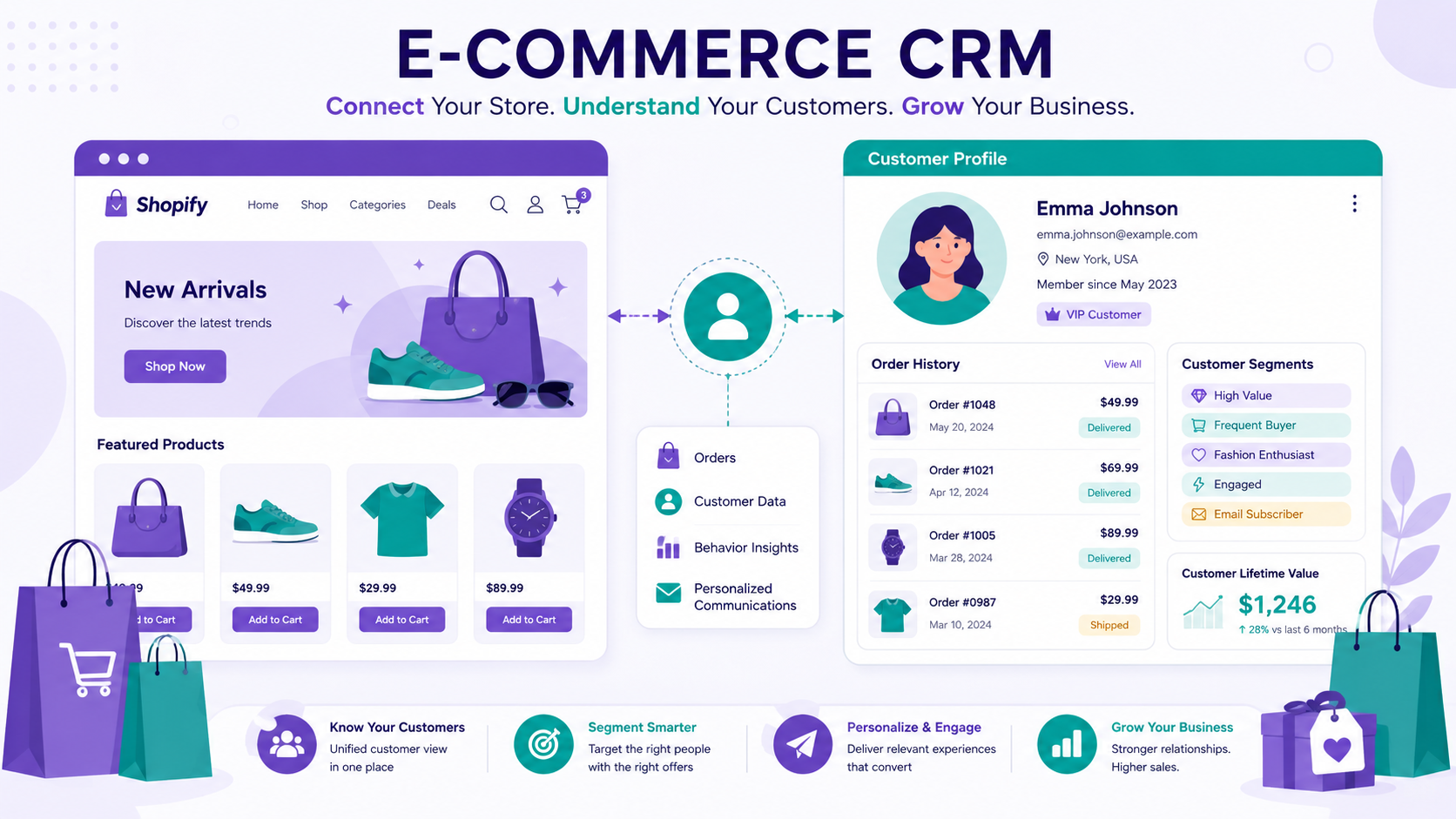
“CRM for ecommerce” means something different than traditional B2B CRM use cases. Ecommerce businesses need customer relationship tools that integrate deeply with order history, purchase behavior, and product catalog data — rather than deal pipelines and sales rep activity tracking that define B2B CRM design.
This guide compares the seven leading platforms serving ecommerce-specific customer relationship needs in 2026, spanning both traditional CRMs adapted for ecommerce and ecommerce-native customer data platforms.
Who This Guide Is For
- Ecommerce store owners wanting unified customer data beyond basic email marketing
- Businesses managing both B2C ecommerce and B2B wholesale relationships
- Stores wanting customer service and support unified with purchase history
- Ecommerce businesses currently relying solely on their store platform’s basic customer data
Traditional CRM vs. Ecommerce Customer Data Platforms
| Approach | What It Offers | Best Suited For |
|---|---|---|
| Traditional CRM (HubSpot, Zoho) | Unified contact records, sales pipeline, customer service ticketing | Ecommerce businesses with B2B/wholesale components, or wanting unified support |
| Ecommerce-native platform (Klaviyo) | Deep behavioral segmentation, purchase prediction, revenue attribution | Pure B2C ecommerce focused primarily on marketing-driven growth |
Why this distinction matters: A pure B2C store focused on marketing automation may get more practical value from Klaviyo’s ecommerce-native segmentation than from a traditional CRM’s sales pipeline features, which may go largely unused.
Quick Comparison Table
| Platform | Starting Price | Native Store Integration | Best For |
|---|---|---|---|
| HubSpot | Free–$20/user/month | Good (via integrations) | Unified sales, service, and marketing |
| Klaviyo | $20/month | Excellent, real-time event sync | Pure ecommerce behavioral segmentation |
| Zoho CRM | $14/user/month | Moderate | Affordable, B2B/wholesale crossover |
| Shopify (native customer tools) | Included in Shopify plan | Native | Basic needs, minimal additional cost |
| Gorgias | $10/month | Excellent | Customer service-focused ecommerce |
| ActiveCampaign | $29/month | Good | Automation-tied customer management |
| Salesforce Commerce Cloud | Custom enterprise pricing | Deep (native commerce platform) | Large enterprise ecommerce |
HubSpot — Best Unified Sales, Service, and Marketing
HubSpot’s broader platform appeal extends to ecommerce businesses wanting customer service, marketing, and any B2B sales activity unified in one system.
Strengths:
- Customer service ticketing unified with purchase and marketing history
- Strong marketing automation alongside basic CRM functionality
- Free tier provides genuine starting functionality
Limitations:
- Native ecommerce platform integration requires third-party connector apps rather than built-in deep event sync
- Real automation depth requires Marketing Hub Professional, a significant cost increase
Pricing: Free CRM; Marketing Hub Starter from $20/user/month.
Best for: Ecommerce businesses wanting unified customer service and any B2B sales activity alongside marketing.
Klaviyo — Best Ecommerce-Native Segmentation
While not a traditional CRM, Klaviyo functions as the closest thing to a customer data platform purpose-built for ecommerce behavioral data.
Strengths:
- Real-time, deep integration with Shopify, WooCommerce, and BigCommerce
- Predictive customer lifetime value and churn risk scoring
- Revenue attribution tied directly to specific customer segments and campaigns
Limitations:
- Not a traditional CRM — no deal pipeline, sales activity tracking, or customer service ticketing
- Less suited to businesses with significant B2B or wholesale relationship management needs
Pricing: Starts at $20/month.
Best for: Pure B2C ecommerce stores prioritizing behavioral segmentation and marketing-driven growth over traditional CRM functionality.
(See our Mailchimp vs Klaviyo guide for further context on Klaviyo’s positioning.)
Zoho CRM — Best for B2B/Wholesale Crossover
Zoho CRM suits ecommerce businesses that also manage B2B or wholesale customer relationships requiring traditional sales pipeline functionality.
Strengths:
- Genuine sales pipeline management for B2B or wholesale accounts alongside B2C customer data
- Affordable pricing relative to feature depth
- Broader Zoho ecosystem (Books, Inventory, Campaigns) integrates affordably
Limitations:
- Less deep real-time ecommerce behavioral tracking than Klaviyo
- Interface feels less polished than premium competitors
Pricing: Starts at $14/user/month.
Best for: Ecommerce businesses managing both B2C sales and B2B/wholesale relationships requiring genuine pipeline tracking.
Shopify Native Customer Tools — Best for Basic, Minimal-Cost Needs
Shopify’s built-in customer management covers basic order history and segmentation without requiring any additional app subscription.
Strengths:
- No additional cost beyond your existing Shopify subscription
- Basic customer segmentation and order history readily available
- Simplest possible setup, since it’s already native to your store
Limitations:
- Lacks the depth of dedicated CRM or customer data platforms for sophisticated segmentation
- No customer service ticketing or sales pipeline functionality
Pricing: Included with Shopify subscription.
Best for: Very early-stage stores wanting basic customer data without additional tool investment.
Gorgias — Best for Customer Service-Focused Ecommerce
Gorgias specializes in ecommerce customer service, with deep order and purchase history integration directly into support ticketing.
Strengths:
- Support tickets automatically display full order and purchase history for context
- Strong native integration with Shopify, BigCommerce, and other major platforms
- Automation for common support requests (order status, returns) reduces manual ticket handling
Limitations:
- Primarily customer service-focused, not a full sales or marketing CRM
- Less relevant for businesses without significant support ticket volume
Pricing: Starts at $10/month.
Best for: Ecommerce businesses wanting customer service deeply unified with purchase history context.
ActiveCampaign — Best Automation-Tied Customer Management
ActiveCampaign combines genuine CRM functionality with sophisticated automation, useful for ecommerce businesses wanting both customer tracking and marketing sophistication.
Strengths:
- Sophisticated automation builder ties customer behavior directly to marketing and sales actions
- Built-in CRM pipeline functionality alongside marketing automation
- Strong value relative to HubSpot’s Professional-tier pricing
Limitations:
- Native ecommerce platform integration is less deep than Klaviyo’s purpose-built event tracking
- CRM functionality, while solid, is secondary to its automation strength
Pricing: Starts at $29/month.
Best for: Ecommerce businesses wanting automation sophistication unified with basic CRM functionality.
(See our CRM with Marketing Automation guide for further detail.)
Salesforce Commerce Cloud — Best for Large Enterprise Ecommerce
Salesforce’s dedicated commerce platform integrates deeply with its broader CRM ecosystem, suited to large-scale enterprise ecommerce operations.
Strengths:
- Deep native integration between commerce platform and CRM data
- Highly customizable for complex, large-scale ecommerce operations
- Strong AI-driven personalization capabilities at enterprise scale
Limitations:
- Significant cost, generally inaccessible for small-to-mid ecommerce businesses
- Implementation complexity requires substantial technical resources
Pricing: Custom enterprise pricing.
Best for: Large enterprise ecommerce operations needing deep CRM and commerce platform integration.
How to Choose the Right Ecommerce CRM
If you want unified sales, service, and marketing: HubSpot.
If you’re pure B2C and want deep behavioral segmentation: Klaviyo.
If you manage B2B/wholesale alongside B2C: Zoho CRM.
If you want basic functionality at no extra cost: Shopify’s native tools.
If customer service is your primary need: Gorgias.
If automation sophistication matters alongside CRM: ActiveCampaign.
If you’re a large enterprise needing deep commerce integration: Salesforce Commerce Cloud.
Building a Complete Ecommerce Customer Data Strategy
Many ecommerce businesses don’t rely on a single platform, but combine tools strategically:
- Klaviyo or similar for behavioral segmentation and marketing automation
- Gorgias or similar for customer service ticketing with purchase context
- A traditional CRM (HubSpot, Zoho) if B2B/wholesale relationships require genuine pipeline tracking
This combined approach often serves ecommerce businesses better than forcing all needs into a single platform not originally designed for the full scope of ecommerce customer relationship management.
Frequently Asked Questions
Is Klaviyo considered a real CRM, or just an email platform?
Klaviyo functions more as a customer data and marketing automation platform than a traditional CRM — it lacks deal pipeline and sales activity tracking but excels at behavioral segmentation and purchase-based customer data.
Do I need a traditional CRM if I only sell B2C through my online store?
Not necessarily — pure B2C ecommerce businesses often get more practical value from ecommerce-native platforms like Klaviyo than from traditional CRM sales pipeline features they won’t use.
Can I use Shopify’s native customer tools instead of a dedicated CRM?
For very early-stage stores with basic needs, yes. As you scale and need deeper segmentation, customer service integration, or B2B pipeline tracking, dedicated platforms offer significantly more capability.
Which platform is best for a store also selling wholesale to retailers?
Zoho CRM or HubSpot both offer genuine B2B pipeline functionality that pure ecommerce platforms like Klaviyo don’t provide, making them better suited to hybrid B2C/B2B business models.
Is it normal to use multiple platforms rather than one unified CRM for ecommerce?
Yes, many successful ecommerce businesses combine a behavioral segmentation tool (Klaviyo), a customer service platform (Gorgias), and sometimes a traditional CRM for B2B needs, rather than forcing everything into one system.
Does Gorgias replace the need for an email marketing platform?
No, Gorgias focuses specifically on customer service ticketing, not marketing campaigns or automation — most stores pair it with Klaviyo or a similar platform for marketing needs.
How much should an ecommerce business budget for CRM and customer data tools?
This varies significantly based on which combination of tools you need, but most small-to-mid ecommerce businesses budget $50-200/month combining a marketing platform with basic customer service tools.
Is Salesforce Commerce Cloud worth it for a growing mid-size ecommerce business?
Generally not yet — it’s positioned for large enterprise scale, and most growing mid-size ecommerce businesses get better practical value from a combination of Klaviyo, Gorgias, and potentially HubSpot or Zoho at a fraction of the cost and complexity.
Final Verdict
The right “CRM” for ecommerce depends heavily on your specific business model. Pure B2C stores prioritizing marketing-driven growth get the most practical value from Klaviyo’s ecommerce-native segmentation. Businesses wanting unified customer service alongside any sales and marketing activity should consider HubSpot, while stores managing both B2C and B2B/wholesale relationships are better served by Zoho CRM’s genuine pipeline functionality.
Many successful ecommerce businesses don’t rely on a single platform at all — combining a behavioral segmentation tool, a customer service platform, and sometimes a traditional CRM often serves the full scope of ecommerce customer relationship needs better than any single system designed primarily for one use case.
Pricing reflects publicly available rates as of mid-2026 and may change. Verify current pricing directly with each vendor.