
TL;DR: Payroll tax compliance requires accurate withholding and timely deposits of federal income tax, Social Security, and Medicare (FICA), plus federal and state unemployment tax (FUTA/SUTA), with deposit schedules and filing deadlines varying based on your business’s deposit frequency classification. Missing deposit deadlines is the most common and costly compliance failure, since penalties accrue immediately and compound the longer the issue goes unaddressed.
Executive Summary
Payroll tax compliance involves more moving parts than most small business owners initially realize — multiple tax types, varying deposit schedules, quarterly and annual filings, and state-specific requirements layered on top of federal obligations. Errors here carry real financial consequences, since the IRS treats payroll tax violations more strictly than many other tax compliance issues, partly because withheld employee taxes are considered held in trust for the government.
This guide provides a complete compliance checklist covering federal, state, and ongoing administrative requirements.
Who This Guide Is For
- Small business owners managing payroll without dedicated HR or accounting staff
- Businesses that recently hired their first employee
- Companies switching payroll providers or bringing payroll in-house
- Anyone auditing their current payroll compliance practices
Federal Payroll Tax Components
1. Federal Income Tax Withholding
Based on each employee’s W-4 elections, withheld from every paycheck and deposited according to your assigned deposit schedule.
2. Social Security and Medicare Tax (FICA)
Both employer and employee contribute 6.2% (Social Security, up to the annual wage base limit) and 1.45% (Medicare, no wage base limit) respectively, for a combined 15.3% total contribution split between employer and employee.
3. Federal Unemployment Tax (FUTA)
Employer-only tax, generally 6% on the first $7,000 of each employee’s wages, though most employers receive a credit reducing the effective rate to 0.6% when state unemployment tax is paid timely.
4. Additional Medicare Tax
An additional 0.9% Medicare tax applies to wages exceeding $200,000 for an individual employee, withheld by the employer once that threshold is crossed within the calendar year.
Deposit Schedule Classification
| Classification | Criteria | Deposit Timing |
|---|---|---|
| Monthly depositor | Total tax liability of $50,000 or less during the lookback period | By the 15th of the following month |
| Semi-weekly depositor | Total tax liability over $50,000 during the lookback period | Within 3 business days of payday, varying by payday timing |
| Next-day depositor | Accumulated $100,000 or more in tax liability on any single day | Next business day |
Critical detail: Your deposit schedule is determined annually based on your tax liability during a specific prior lookback period — confirm your current classification each year rather than assuming it remains constant.
Federal Filing Requirements
| Form | Purpose | Frequency |
|---|---|---|
| Form 941 | Quarterly federal tax return reporting withheld income tax, Social Security, and Medicare | Quarterly |
| Form 940 | Annual federal unemployment tax return | Annually |
| Form W-2 | Annual wage and tax statement for each employee | Annually, due to employees by January 31 |
| Form W-3 | Transmittal summary of all W-2s filed with the Social Security Administration | Annually, alongside W-2 filing |
State Payroll Tax Obligations
State requirements vary significantly and typically include:
- State income tax withholding (in states that impose income tax)
- State unemployment insurance (SUTA) tax, with rates varying by employer and often adjusted based on claims history
- State disability insurance in states that require it (California, New York, New Jersey, Rhode Island, Hawaii)
- Local/municipal payroll taxes in certain jurisdictions (some cities impose additional local income or payroll taxes)
Important: Always verify requirements specific to every state where you have employees working, not just where your business is headquartered — remote work arrangements have made multi-state payroll compliance significantly more common and complex.
New Employee Compliance Requirements
- Collect a completed Form W-4 before the first payroll run
- Verify employment eligibility using Form I-9 within the required timeframe
- Report new hires to your state’s new hire reporting system, typically required within 20 days of hire
- Set up state withholding elections if your state requires a separate state-specific withholding form
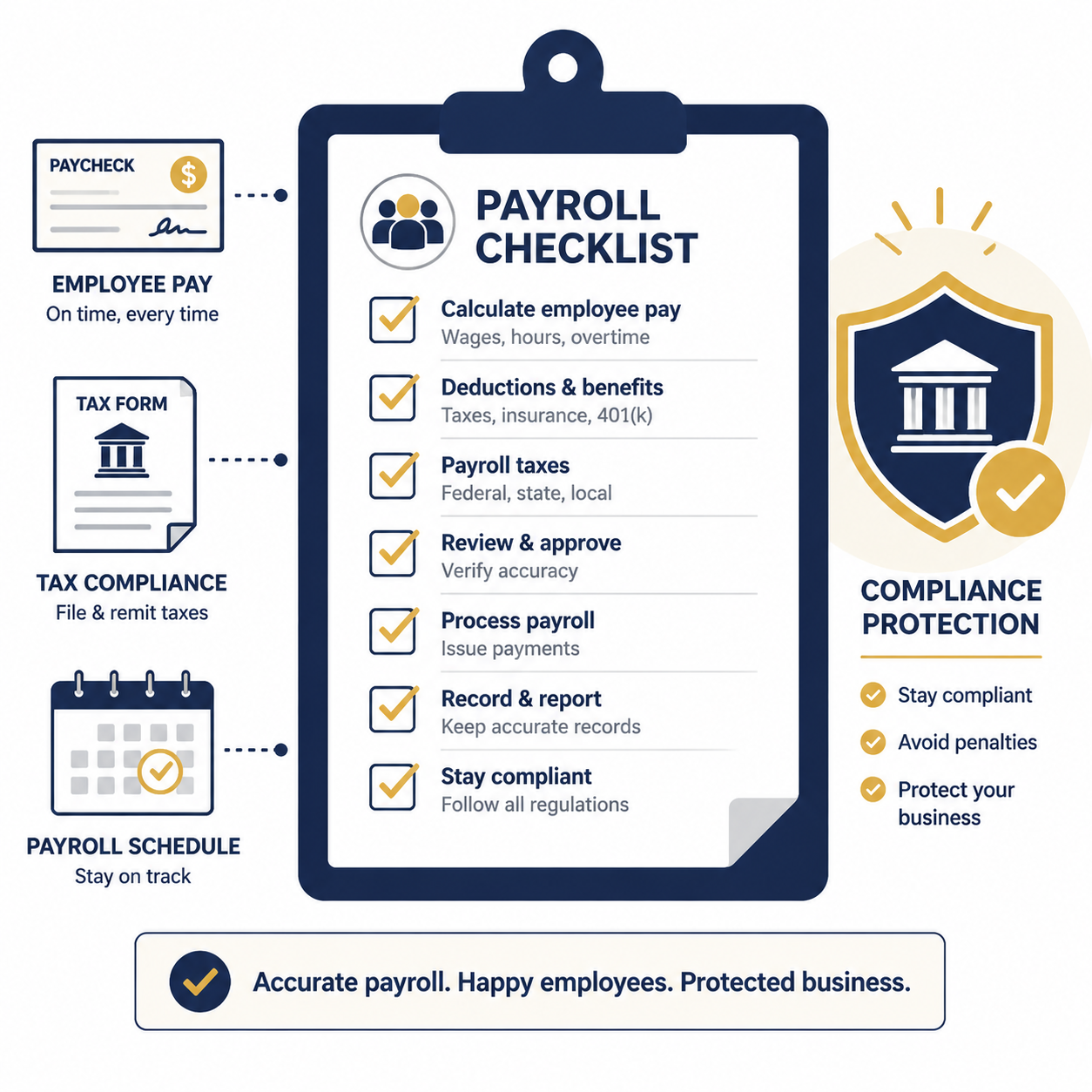
Ongoing Compliance Checklist
Every Pay Period
- [ ] Calculate and withhold correct federal income tax based on current W-4 elections
- [ ] Calculate and withhold FICA (Social Security and Medicare) correctly
- [ ] Calculate and withhold applicable state and local taxes
- [ ] Deposit withheld taxes according to your assigned deposit schedule
Quarterly
- [ ] File Form 941 by the required deadline (generally the last day of the month following quarter-end)
- [ ] Reconcile quarterly totals against your payroll records for accuracy
- [ ] Review and update SUTA rate if your state has issued a new rate notice
Annually
- [ ] File Form 940 for federal unemployment tax
- [ ] Distribute Form W-2 to all employees by January 31
- [ ] File Form W-3 and copies of all W-2s with the Social Security Administration
- [ ] Verify your deposit schedule classification for the upcoming year based on the new lookback period
- [ ] Review and update state unemployment insurance rate notices
Common Payroll Tax Compliance Mistakes
| Mistake | Consequence |
|---|---|
| Missing deposit deadlines | Penalties begin accruing immediately, increasing the longer the deposit remains late |
| Misclassifying employees as independent contractors | Significant back-tax liability plus penalties if misclassification is identified |
| Incorrect deposit schedule classification | Triggers penalties even if taxes are eventually paid, due to incorrect timing |
| Failing to update state withholding for multi-state remote employees | Non-compliance with the employee’s actual work-location state requirements |
| Not reconciling quarterly Form 941 against actual payroll records | Discrepancies can trigger IRS inquiries or notices |
Penalties for Payroll Tax Non-Compliance
| Violation | Typical Penalty |
|---|---|
| Late deposit (1-5 days) | 2% of the unpaid amount |
| Late deposit (6-15 days) | 5% of the unpaid amount |
| Late deposit (16+ days or within 10 days of IRS notice) | 10% of the unpaid amount |
| Failure to deposit at all | 15% of the unpaid amount |
| Failure to file required returns | Additional penalties calculated separately from deposit penalties |
Critical point: The IRS can also pursue the Trust Fund Recovery Penalty personally against responsible individuals (often the business owner) for willfully unpaid withheld employee taxes, bypassing the liability protection that might otherwise apply to a business entity.
Should You Use a Payroll Service?
| Factor | DIY Payroll | Payroll Service (Gusto, ADP, etc.) |
|---|---|---|
| Cost | Lower direct cost, but higher time investment | $40-150+/month depending on employee count |
| Compliance risk | Higher, requires staying current on changing requirements yourself | Lower, service typically handles deposit timing and filing automatically |
| Time investment | Significant ongoing time commitment | Minimal once set up correctly |
Practical recommendation: For most small businesses beyond a couple of employees, a dedicated payroll service significantly reduces compliance risk and time investment relative to its modest cost.
Frequently Asked Questions
What happens if I miss a payroll tax deposit deadline?
Penalties begin accruing immediately based on how many days late the deposit is, starting at 2% and increasing up to 15% for deposits not made even after IRS notice, plus interest on the unpaid amount.
How do I know if I’m a monthly or semi-weekly depositor?
This is determined annually based on your total tax liability during a specific prior lookback period — the IRS notifies you of your classification, but you should also calculate and verify it yourself each year.
Do I need to comply with payroll tax requirements in states where I don’t have an office, but have remote employees?
Yes, generally you must comply with payroll tax withholding and reporting requirements in every state where employees actually perform work, regardless of where your business is officially headquartered.
Is using a payroll service enough to guarantee compliance?
Payroll services significantly reduce compliance risk by automating deposit timing and filing, but you remain ultimately responsible for providing accurate information (employee classifications, wage data) that the service relies on.
What’s the Trust Fund Recovery Penalty, and why does it matter?
This penalty allows the IRS to pursue responsible individuals personally for willfully unpaid withheld employee taxes, since this money is considered held in trust for the government rather than the business’s own funds — it can bypass typical business entity liability protections.
How often do payroll tax rates and thresholds change?
Federal Social Security wage base limits typically adjust annually, and state unemployment insurance rates often change based on your claims history — review your specific rates at the start of each calendar year.
What should I do if I discover a past payroll tax compliance error?
Address it proactively rather than waiting for an IRS notice — voluntary correction, even with some penalty exposure, is typically treated more favorably than errors discovered through audit or enforcement action.
Do payroll tax requirements differ for part-time versus full-time employees?
Generally no for the core federal withholding requirements, though certain benefits-related obligations and some state-specific requirements may have different thresholds based on hours worked.
Final Verdict
Payroll tax compliance involves genuine complexity across federal, state, and sometimes local requirements, with real financial and personal liability consequences for errors. The deposit schedule and timely filing requirements represent the highest-risk compliance areas, since penalties accrue immediately and the Trust Fund Recovery Penalty can extend liability personally to responsible individuals.
For most small businesses beyond a very small employee count, a dedicated payroll service meaningfully reduces this compliance burden and risk relative to its modest cost — review your current payroll setup against this checklist regardless of whether you manage payroll in-house or through a service.
This guide provides general informational content based on federal requirements as of mid-2026 and does not constitute tax or legal advice. State and local requirements vary significantly — consult a qualified accountant or payroll professional for guidance specific to your business and jurisdictions.