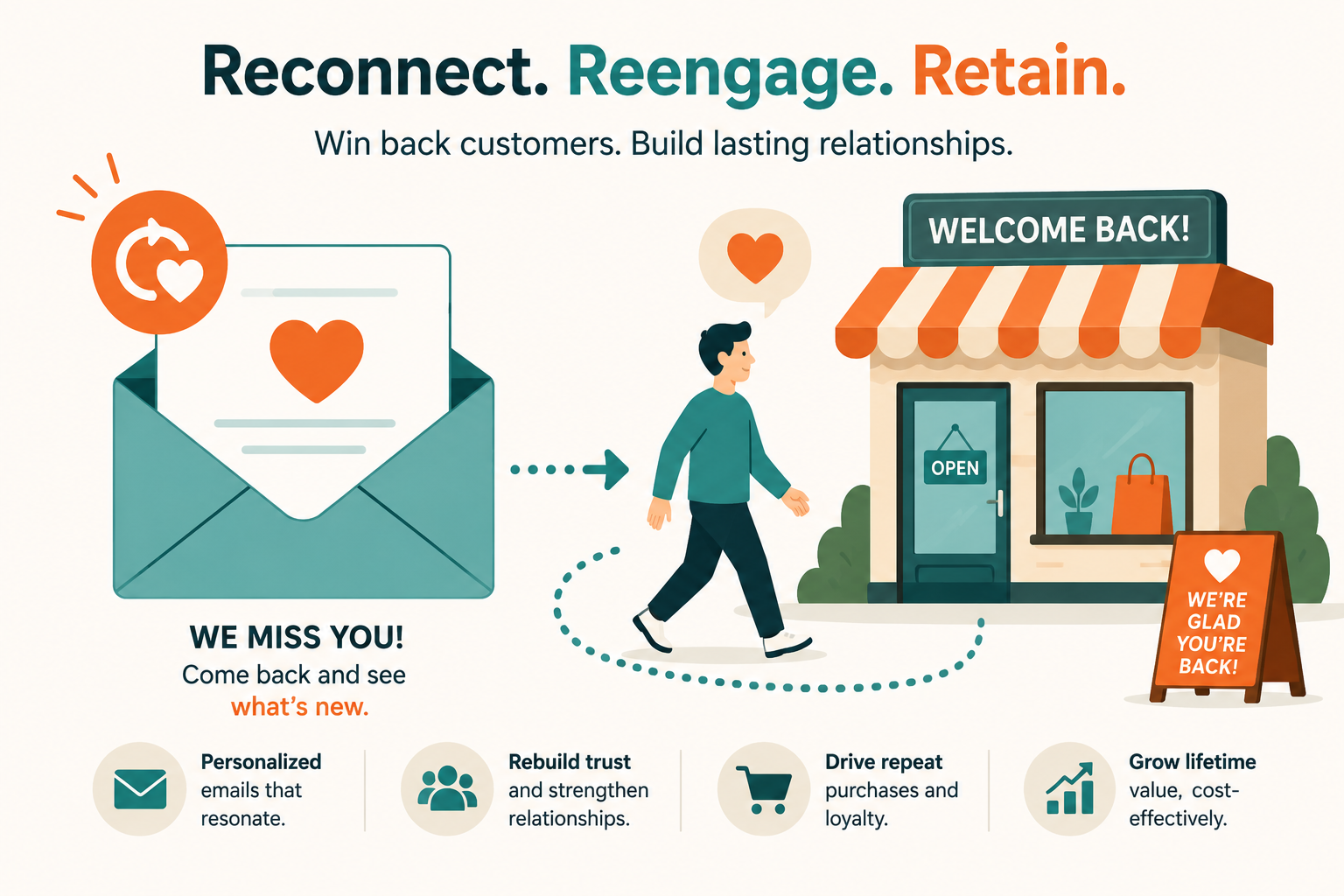

TL;DR: Effective winback campaigns trigger after 60-90 days of customer inactivity, using a 3-email escalation: a simple “we miss you” check-in, social proof or new product highlights, and a final incentive-led offer before final suppression. Below are 10 example structures covering each stage, plus the segmentation logic and timing that drives the highest reactivation rates.
Executive Summary
Acquiring a new customer typically costs significantly more than retaining or reactivating an existing one, making winback campaigns one of the highest-ROI email automations available. Yet many businesses either skip winback entirely or send a single generic “come back” email rather than a structured, escalating sequence.
This guide provides 10 example winback email structures across different stages of customer lapse, along with the segmentation and timing strategy that drives genuine reactivation rather than just unsubscribes.
Who This Guide Is For
- Ecommerce store owners wanting to re-engage lapsed customers systematically
- SaaS businesses building churn-reduction reactivation sequences
- Marketers improving an existing winback flow’s conversion rate
- Anyone using Klaviyo, Omnisend, or similar platforms needing copy inspiration
Defining “Lapsed” for Your Business
Before building a winback sequence, define what inactivity period actually signals genuine lapse for your specific business model:
| Business Type | Typical Lapse Threshold |
|---|---|
| Fast-moving consumables (coffee, skincare) | 30-45 days |
| General ecommerce (apparel, home goods) | 60-90 days |
| Considered purchases (furniture, electronics) | 120-180 days |
| SaaS/subscription | Defined by usage drop-off, not just purchase timing |
The Winback Sequence Structure
| Timing After Lapse Threshold | Goal | |
|---|---|---|
| Email 1 | Day 0 | Gentle check-in, no hard sell |
| Email 2 | Day 5-7 | Highlight what’s new, social proof |
| Email 3 | Day 12-14 | Direct incentive-led final offer |
| Suppression/Survey | Day 20+ | Move to long-term list or send a final feedback survey |
Email 1 Examples: The Gentle Check-In
Example 1: Simple “We Miss You”
Subject: We miss you, [First Name]
Body:
Hi [First Name],
It’s been a while since your last order, and we wanted to check in. Is there anything we can help with?
[Browse What’s New button]
If something didn’t work out with a past order, just reply — we’re happy to help.
Why it works: Opens a genuine conversation rather than immediately pushing a sale, appropriate for the first re-engagement touch.
Example 2: Curiosity-Driven
Subject: Did we do something wrong?
Body:
[First Name],
We noticed you haven’t shopped with us in a while, and we’d genuinely like to know why. Did something not meet expectations, or have your needs simply changed?
[Quick 1-question survey link]
Either way, we’re here if you need us.
Why it works: Direct, honest framing often prompts genuine replies that reveal actionable feedback, beyond just driving a purchase.
Example 3: What’s New Highlight
Subject: Here’s what you’ve missed
Body:
Hi [First Name],
A lot has changed since your last visit — new arrivals, improved [product feature], and customer favorites you haven’t seen yet.
[Shop New Arrivals button]
Why it works: Reframes the re-engagement around discovery rather than directly addressing the lapse, useful for brands with frequent new product releases.
Email 2 Examples: Social Proof and New Value
Example 4: Customer Favorites
Subject: Customers are loving this right now
Body:
[First Name], in case you missed it —
[Product image with review snippet]
“[Genuine customer review]” — [Customer name]
[Shop Bestsellers button]
Why it works: Uses social proof to rebuild interest without an explicit “come back” framing, appropriate as a softer second touch.
Example 5: Loyalty/Rewards Reminder
Subject: You have [X] points waiting
Body:
Hi [First Name],
You currently have [X] loyalty points sitting in your account — that’s [$ value] toward your next order.
[Redeem Points button]
Why it works: Reminds customers of existing value already tied to their account, often more compelling than a generic discount since it feels like reclaiming something already theirs.
Example 6: Product Improvement Update
Subject: We upgraded the thing you used to love
Body:
[First Name],
Since your last order, we’ve made meaningful improvements to [product/feature]: [brief specific improvement details].
[See What’s Improved button]
Why it works: Particularly effective for customers who lapsed due to a specific past dissatisfaction that has genuinely since been addressed.
Example 7: Community/Brand Story
Subject: A quick update from our team
Body:
Hi [First Name],
A lot has happened since you last shopped with us — [brief, genuine brand update: new sustainability initiative, milestone, etc.].
We’d love to have you back as part of our community.
[Shop Now button]
Why it works: Builds emotional reconnection through brand storytelling rather than purely transactional messaging, useful for brands with a strong identity or mission.
Email 3 Examples: The Final Incentive
Example 8: Meaningful Discount
Subject: 20% off, just for you
Body:
[First Name], we’d really love to see you again.
Use code WELCOME20 for 20% off your next order — valid for the next 7 days.
[Shop Now With Discount button]
Why it works: A more substantial discount than typical abandoned cart offers is justified here since you’re trying to overcome a longer period of disengagement, not just momentary hesitation.
Example 9: Free Gift With Purchase
Subject: A little something to welcome you back
Body:
Hi [First Name],
Place an order in the next 5 days and we’ll include [specific free gift] — no code needed, it’s automatic at checkout.
[Shop Now button]
Why it works: A free gift can feel more generous and less margin-eroding than a percentage discount, while still providing meaningful incentive.
Example 10: Last Chance / Account Closing Framing
Subject: Before we say goodbye…
Body:
[First Name],
We haven’t heard from you in a while, and we don’t want to keep emailing if you’re not interested. Before we reduce how often we reach out, here’s 25% off if you’d like to shop again:
[Shop Now button]
Prefer we stop emailing entirely? [Unsubscribe link]
Why it works: Honest framing about reducing email frequency often prompts action from genuinely interested but distracted customers, while giving truly uninterested customers a clear, low-friction exit.
What to Do With Non-Responders After the Sequence
- Move to a reduced-frequency list — quarterly brand updates rather than regular marketing cadence, keeping the relationship alive without continued list fatigue
- Send a final feedback survey — even without conversion, understanding why customers lapsed provides valuable product or service insight
- Suppress entirely after a defined period — continuing to email genuinely disengaged contacts indefinitely damages overall sender reputation
Segmentation Considerations for Winback Campaigns
| Segment | Adjusted Approach |
|---|---|
| High-value past customers | More personalized outreach, potentially a direct human touch (phone call, personalized email) rather than only automated sequence |
| One-time purchasers | Focus on addressing potential first-purchase friction or hesitation |
| Previously frequent, now lapsed | Investigate and address specific reasons for the change in behavior directly |
| Subscription cancellations (SaaS) | Survey-driven approach to understand cancellation reason before any reactivation offer |
Frequently Asked Questions
How long should a winback sequence run before giving up?
Most effective sequences run 3 emails over 2-3 weeks, after which non-responders should move to a reduced-frequency list rather than continued regular marketing cadence.
Should winback discounts be larger than abandoned cart discounts?
Generally yes — you’re working to overcome a longer period of disengagement, which often justifies a more substantial incentive than the lighter nudge needed for a fresh cart abandonment.
What’s a good reactivation rate to expect from a winback campaign?
This varies significantly by industry and lapse definition, but well-optimized sequences commonly reactivate 5-15% of targeted lapsed customers.
Should I remove customers from my list if winback doesn’t work?
Continuing to email genuinely unresponsive contacts indefinitely can hurt deliverability. Move them to a reduced-frequency list or suppress entirely after a defined non-response period.
Is it worth asking lapsed customers directly why they stopped purchasing?
Yes, a simple survey question often yields valuable, actionable feedback beyond what the winback sequence alone reveals, even from customers who don’t ultimately reactivate.
Should SaaS winback campaigns differ from ecommerce ones?
Yes, SaaS reactivation typically needs to address the specific reason for reduced usage or cancellation directly, often requiring more personalized outreach than a generic ecommerce discount-led approach.
How do I identify the right “lapsed” threshold for my business?
Look at your typical repurchase cycle — if customers normally reorder every 30 days, a 60-90 day gap likely signals genuine lapse rather than normal purchase timing variation.
Can winback campaigns hurt my brand if customers feel targeted?
Tone matters significantly — overly aggressive or manipulative framing can feel intrusive. The honest, conversational approach (Examples 1, 2, and 10) generally performs better than purely transactional messaging.
Final Verdict
The strongest winback sequences escalate gradually: starting with a genuine, low-pressure check-in, building interest through social proof or new value in the second touch, and reserving meaningful incentives for the final email before suppression. Resist sending only a single generic “come back” email — the structured, escalating approach consistently outperforms one-off attempts at reactivation.
Use the 10 examples above as a foundation, but always segment by customer value and lapse pattern where possible — a one-time purchaser and a previously frequent customer who suddenly stopped buying deserve meaningfully different messaging approaches.
Examples are illustrative templates intended for adaptation to your specific brand voice and customer base. Reactivation rate benchmarks reflect general industry trends as of mid-2026 and will vary by business.