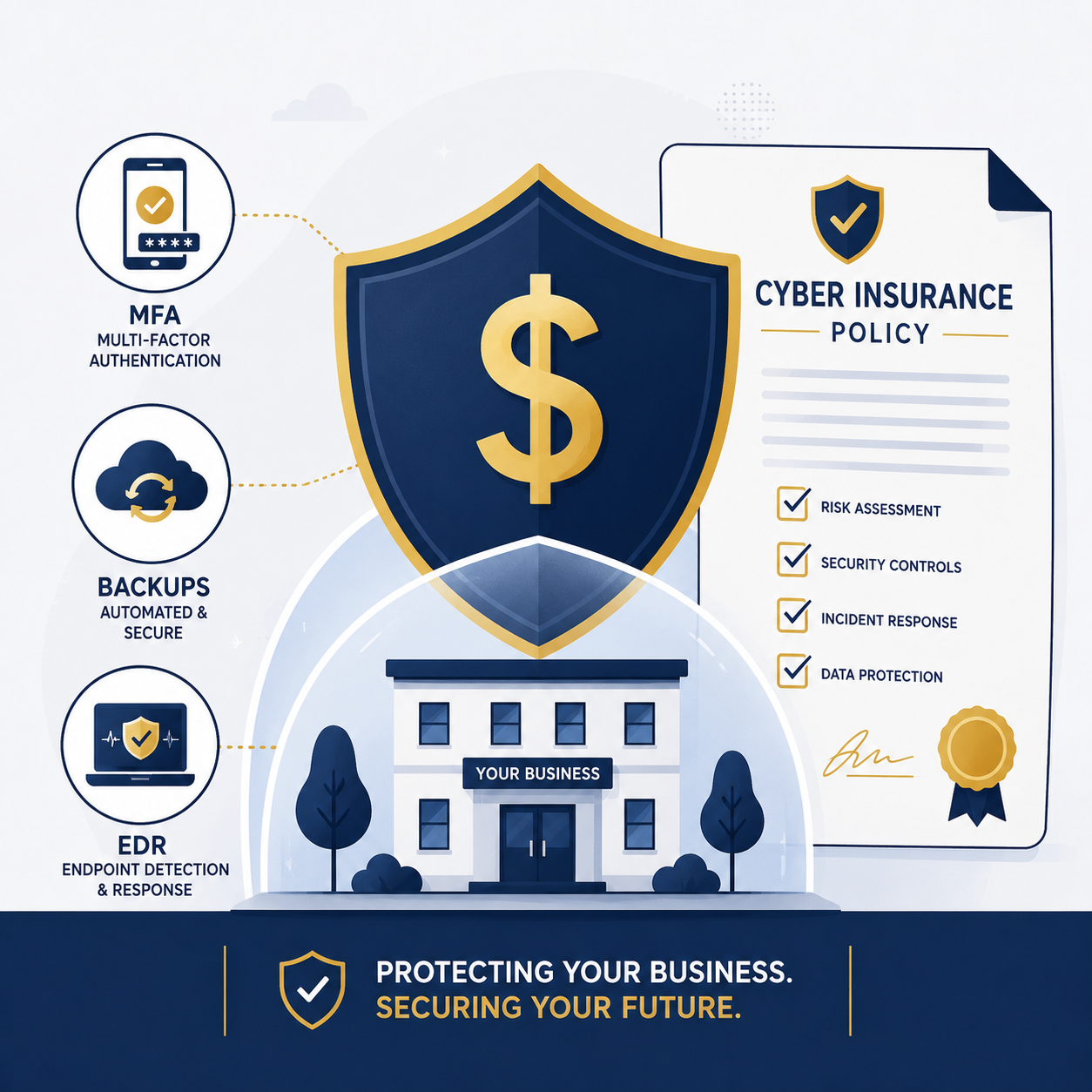

TL;DR: In 2026, most insurers will not issue or renew a cyber policy without proof of multi-factor authentication (MFA), endpoint detection and response (EDR), tested backups, and a written incident response plan. Businesses that lack these controls either get denied coverage, pay significantly higher premiums, or face reduced payouts after a claim. Below, we break down exactly what insurers require and how to prepare your application.
Executive Summary
Cyber insurance has changed dramatically over the past three years. What used to be a simple application form with basic yes/no questions is now closer to a security audit. Insurers got burned by a wave of ransomware claims in the early 2020s, and their response has been to tighten underwriting requirements significantly.
For small businesses, this means cyber insurance is no longer something you can buy passively — it now requires you to actually implement baseline security controls before an insurer will even quote you a policy.
This guide explains exactly what’s required in 2026, what it costs, and how to prepare before you apply.
Who This Guide Is For
- Small business owners shopping for cyber insurance for the first time
- Businesses facing a coverage denial or non-renewal
- Companies that experienced a recent rate increase and want to understand why
- IT and operations teams preparing a security stack ahead of a renewal audit
Why Cyber Insurance Requirements Got Stricter
Ransomware claims surged dramatically between 2020 and 2023, with average claim payouts far exceeding insurers’ actuarial projections. In response, the insurance industry shifted from broad, easy-to-qualify policies toward controls-based underwriting — meaning your premium and eligibility now depend directly on your demonstrated security posture, not just your industry and revenue.
This mirrors how auto insurers price based on driving record rather than just car value. Insurers now want evidence you’re actively reducing risk, not just buying a financial safety net.
The Core Requirements Insurers Check in 2026
1. Multi-Factor Authentication (MFA)
This is the single most common requirement across nearly all cyber insurance applications today. Insurers specifically ask whether MFA is enabled on:
- Email accounts (especially Microsoft 365 and Google Workspace admin accounts)
- Remote access tools (VPN, RDP)
- Privileged or administrator accounts
- Cloud backup and storage systems
Reality check: Lack of MFA on remote access or email is one of the top reasons applications are denied outright or quoted at a significantly higher premium.
2. Endpoint Detection and Response (EDR)
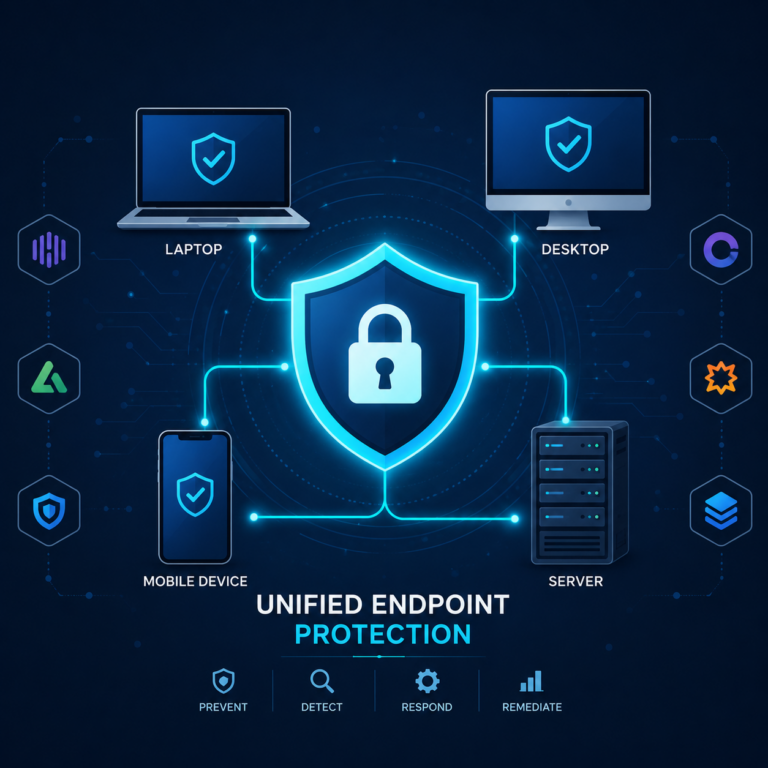
Basic antivirus is no longer sufficient for most insurers. Many now require EDR — software that monitors for suspicious behavior, not just known malware signatures — on all business endpoints.
What qualifies: Platforms like CrowdStrike, Sophos Intercept X, or Microsoft Defender for Business with EDR capabilities enabled.
3. Regular, Tested, and Segmented Backups
Insurers increasingly ask not just “do you have backups” but “are your backups segmented from your main network” and “have you tested restoring from them.” Backups that are accessible from the same network as production systems can be encrypted in a ransomware attack along with everything else — insurers know this and ask pointed questions about it.
What qualifies: Following the 3-2-1 backup rule (3 copies, 2 different media types, 1 offsite/offline) with documented restore testing.
4. Email Security and Phishing Protection
Given that the majority of ransomware incidents start with a phishing email, insurers now ask about:
- Email filtering and anti-phishing tools
- DMARC, SPF, and DKIM email authentication records
- Employee phishing simulation training frequency
5. Written Incident Response Plan
Insurers want documented evidence that your business knows what to do in the first 24 hours of an incident — who to call, how to isolate affected systems, and how to notify affected parties if required by law.
6. Privileged Access Management
Applications increasingly ask how many employees have administrator-level access and whether that access is regularly reviewed and limited to only those who need it.
7. Vendor and Third-Party Risk Management
Some insurers now ask about due diligence on critical vendors, particularly if those vendors have access to your systems or customer data.
What Happens If You Don’t Meet These Requirements
| Scenario | Likely Outcome |
|---|---|
| No MFA on email/remote access | Application denied or high-risk premium surcharge |
| No EDR, basic antivirus only | Reduced ransomware coverage limits or denial |
| Unsegmented or untested backups | Claim payout reduced if backups fail during an actual incident |
| No incident response plan | Higher premium, sometimes mandatory remediation before binding coverage |
| Misrepresenting your security posture on the application | Claim denial after a breach, even if the policy was active |
The last point is critical: insurers actively investigate security claims after a breach. If your application stated you had MFA enabled and an investigation reveals you didn’t, your claim can be denied entirely — leaving you to cover incident costs out of pocket.
Estimated Cyber Insurance Costs in 2026
| Business Size | Estimated Annual Premium | Typical Coverage Limit |
|---|---|---|
| 1–10 employees | $750–$2,500 | $250,000–$1,000,000 |
| 11–50 employees | $2,000–$7,500 | $1,000,000–$3,000,000 |
| 51–200 employees | $7,500–$25,000+ | $3,000,000–$10,000,000 |
Factors that increase premiums:
- Handling sensitive data (healthcare, financial, legal industries)
- Prior breach or claim history
- Lack of required security controls listed above
- Higher requested coverage limits
Factors that reduce premiums:
- Full MFA deployment across all systems
- EDR with 24/7 monitoring
- Documented and tested incident response plan
- Security awareness training completed within the last 12 months
What Cyber Insurance Typically Covers
- Incident response costs — forensic investigation, legal counsel, PR/crisis management
- Data breach notification costs — required notifications to affected customers under state/federal law
- Ransomware payments — some policies cover ransom payments, though this is increasingly scrutinized and sometimes excluded
- Business interruption — lost income during system downtime caused by an incident
- Third-party liability — claims from customers or partners affected by a breach involving their data
- Regulatory fines — coverage for fines under regulations like HIPAA or state privacy laws (coverage varies significantly by policy)
What Cyber Insurance Typically Excludes
- Pre-existing breaches or vulnerabilities known before the policy was issued
- Acts of war or nation-state attacks — some insurers have widened “war exclusion” clauses following high-profile state-sponsored incidents
- Failure to maintain stated security controls — if you misrepresented your posture at application or let it lapse
- Reputational damage beyond direct financial loss in most standard policies
How to Prepare Your Business Before Applying
Step 1: Run a Self-Audit (2 weeks before applying)
Document your current MFA coverage, antivirus/EDR platform, backup configuration, and any existing security policies.
Step 2: Close the Biggest Gaps First
Prioritize MFA on email and remote access — this single control affects eligibility and pricing more than almost any other factor.
Step 3: Document Everything
Insurers want evidence, not just verbal assurance. Screenshot your MFA settings, export your EDR dashboard showing active deployment, and keep records of backup test results.
Step 4: Write a Basic Incident Response Plan
Even a one-page plan covering “who do we call, how do we isolate affected systems, who notifies customers” satisfies many insurers’ baseline requirement.
Step 5: Get Multiple Quotes
Underwriting standards and pricing vary meaningfully between insurers. Work with a broker who specializes in cyber liability for SMBs rather than applying to a single carrier directly.
Frequently Asked Questions
Is cyber insurance legally required for small businesses?
No, cyber insurance is not legally mandated in most jurisdictions, though certain industries (healthcare, finance) may face contractual requirements from partners or regulatory pressure that makes it effectively necessary.
Can I get cyber insurance without MFA enabled?
It’s increasingly difficult. Most insurers either deny coverage outright or significantly increase premiums and reduce ransomware-specific coverage limits for businesses without MFA on critical systems.
Will my claim be denied if I don’t have an incident response plan?
Not having one rarely causes outright denial on its own, but it typically results in higher premiums, and insurers may require you to develop one as a condition of binding or renewing coverage.
Does cyber insurance cover ransom payments?
Some policies do, but coverage is increasingly scrutinized and may require law enforcement notification or specific conditions. Some insurers have begun excluding or limiting ransom payment coverage entirely due to regulatory pressure.
How often do I need to renew or update my security controls for my policy?
Most policies require annual renewal applications, during which your security controls are reassessed. Significant changes (adding remote workers, new systems) should also be disclosed proactively.
What’s the most common reason small businesses get denied cyber insurance?
Lack of MFA on email and remote access systems is consistently the top reason for denial or significant premium surcharges in 2026 underwriting.
Does having cyber insurance reduce my actual security risk?
No — insurance transfers financial risk but does nothing to prevent an incident. The underwriting requirements exist precisely because insurers want you to reduce the likelihood of a claim in the first place.
How much coverage does a small business actually need?
This depends on the sensitivity of data you handle and your potential business interruption cost. As a starting benchmark, many small businesses carry coverage equal to 10-20% of annual revenue, though data-sensitive industries often carry more.
Final Verdict
Cyber insurance in 2026 functions less like a simple financial safety net and more like a security certification process. Insurers now require demonstrable MFA, EDR, tested backups, and documented incident response before they’ll quote competitive coverage — and they actively verify these claims after an incident.
The businesses that get the best rates and smoothest claims experience are the ones that treat these requirements as genuine security improvements, not just insurance paperwork. Implement the controls first, then apply — you’ll qualify for better coverage at a lower premium, and you’ll actually reduce your risk of needing to file a claim at all.
Information reflects general cyber insurance industry trends and requirements as of mid-2026. Specific requirements, exclusions, and pricing vary significantly by insurer and individual business risk profile. Consult a licensed insurance broker for coverage tailored to your business.