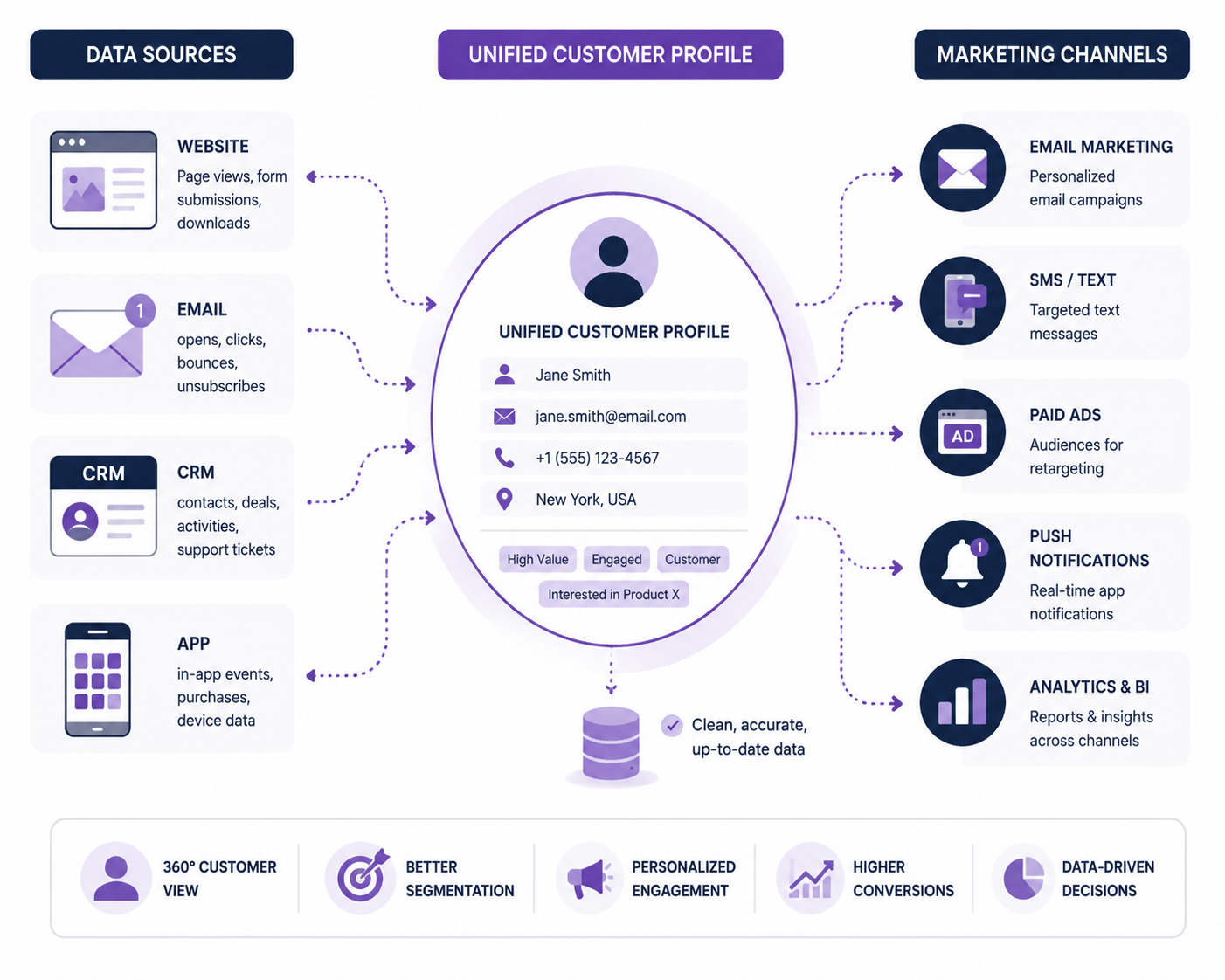

TL;DR: A customer data platform (CDP) unifies customer data from multiple sources — website behavior, email engagement, purchase history, app usage — into a single, persistent customer profile that other marketing and sales tools can access. Unlike a CRM (which is sales-rep-facing and contact-centric) or analytics tools (which report on aggregate trends), a CDP’s core purpose is creating a unified, individual-level data layer that powers personalization and segmentation across your entire tech stack.
Executive Summary
Most businesses have customer data scattered across multiple disconnected systems: website analytics in one tool, email engagement in another, purchase history in their ecommerce platform, and support tickets in a separate help desk system. A customer data platform exists specifically to unify this fragmented data into a single, queryable customer profile, eliminating the need to manually reconcile data across systems for marketing or personalization purposes.
This guide explains what a CDP actually does, how it differs from adjacent tools, and when your business genuinely needs one.
Who This Guide Is For
- Marketing and data teams confused by CDP terminology and vendor positioning
- Businesses with customer data scattered across multiple disconnected tools
- Companies evaluating whether they need a dedicated CDP or can rely on existing CRM/analytics tools
- Anyone researching CDP vendors before a purchasing decision
What a CDP Actually Does
1. Data Collection and Unification
A CDP ingests data from multiple sources — website tracking, email platforms, CRM, ecommerce systems, support tools, mobile apps — and resolves it into a single profile per customer, even when the same person interacts across different channels using different identifiers.
2. Identity Resolution
This is the core technical function: matching anonymous website visitor data, email engagement, and offline purchase records to the same individual customer profile, even when they haven’t logged in or provided consistent identification across every touchpoint.
3. Segmentation
Once unified, customer data can be segmented based on combined criteria across all sources — for example, “customers who viewed a specific product category on the website AND opened the last three emails AND haven’t purchased in 60 days.”
4. Activation
The unified, segmented data is then made available to downstream tools — email platforms, ad platforms, personalization engines — without each tool needing direct access to every original data source.
CDP vs. CRM vs. Analytics: Key Differences
| Factor | CDP | CRM | Analytics Platform |
|---|---|---|---|
| Primary purpose | Unify data across sources for activation | Manage sales relationships and pipeline | Report on aggregate trends and behavior |
| Data scope | All customer touchpoints, often including anonymous behavior | Primarily known contacts and sales activity | Aggregate visitor/user behavior, often anonymized |
| User-facing | No, primarily a data layer for other tools | Yes, sales reps interact directly | Yes, marketers/analysts review reports |
| Identity resolution | Core function | Limited, primarily manual contact management | Limited, session-based rather than identity-based |
Key distinction: A CDP isn’t something your team directly works in day-to-day like a CRM — it’s infrastructure that powers other tools with unified data, often operating largely behind the scenes.
Do You Actually Need a CDP?
Signs You Might Need One
- Customer data is meaningfully fragmented across 4+ disconnected systems
- You want to segment marketing campaigns based on combined behavior across multiple channels (web + email + purchase history simultaneously)
- You’re manually exporting and combining data from multiple tools for personalization or segmentation purposes
- You have sufficient data volume and marketing sophistication to benefit from advanced, cross-channel segmentation
Signs You Probably Don’t Need One Yet
- Your business operates primarily through one or two core systems (e.g., just Shopify and Klaviyo) that already share data natively
- Your segmentation needs are relatively simple and already well-served by your existing email or CRM platform’s built-in capabilities
- You lack sufficient data volume or marketing operations maturity to leverage advanced cross-channel personalization
- Budget constraints make a dedicated CDP difficult to justify relative to its complexity and cost
Leading CDP Platforms (Brief Overview)
| Platform | Positioning | Best For |
|---|---|---|
| Segment (Twilio) | Developer-focused, flexible data routing | Technical teams wanting maximum integration flexibility |
| Tealium | Enterprise-grade, strong identity resolution | Large enterprises with complex data ecosystems |
| mParticle | Mobile-first, strong app data handling | Businesses with significant mobile app data needs |
| Salesforce Data Cloud | Native Salesforce ecosystem integration | Salesforce-centric enterprises |
| Klaviyo (CDP-like features) | Ecommerce-native, simpler unification | Ecommerce businesses wanting lighter CDP-like functionality |
Important nuance: Some marketing platforms (like Klaviyo) now offer CDP-like unification specifically within the ecommerce context, without requiring a fully separate, dedicated CDP — often sufficient for businesses whose data sources are already concentrated in their ecommerce and email ecosystem.
CDP Implementation Considerations
Cost
Dedicated enterprise CDPs (Segment, Tealium, mParticle) typically range from several thousand to tens of thousands of dollars monthly depending on data volume, making them a significant investment generally justified only at meaningful scale.
Technical Resources
Implementation typically requires development resources to properly configure data sources, identity resolution rules, and downstream tool integrations — this isn’t typically a marketing-team-only implementation.
Data Governance
Centralizing customer data in one platform increases the importance of proper access controls, data retention policies, and privacy compliance management, since the CDP becomes a comprehensive repository of customer information.
CDP and Privacy Compliance
Since a CDP centralizes substantial personal data, it carries meaningful privacy compliance implications:
- Right to erasure requests must propagate properly — deleting a customer’s data in the CDP should trigger appropriate deletion or suppression across connected downstream tools
- Consent management needs to be respected across the unified profile, ensuring marketing activation only occurs for properly consented data
- Data minimization principles apply to CDP data just as with any other personal data repository — collecting and retaining only data with genuine business purpose
(For broader context, see our Data Retention Policy for Analytics and GDPR Compliant Email Marketing guides.)
Alternatives to a Full CDP
For businesses not ready for a dedicated enterprise CDP, several lighter-weight approaches can capture some of the same value:
- Native integrations between existing tools — connecting your ecommerce platform, email tool, and CRM directly without a separate unification layer
- Ecommerce-native segmentation tools (Klaviyo) that already unify behavioral and purchase data within their own ecosystem
- Data warehouse plus business intelligence tool — for businesses with technical resources, building unified reporting in a data warehouse without full CDP activation capability
- Zapier or similar automation tools for simpler, rule-based data syncing between specific tool pairs without full identity resolution sophistication
Frequently Asked Questions
Is a CDP the same thing as a CRM?
No, a CRM is primarily a sales-rep-facing tool for managing contacts and deals, while a CDP is an underlying data infrastructure layer unifying data across many sources, often without a dedicated user interface for daily work.
Do small businesses need a dedicated CDP?
Generally not — most small businesses are better served by native integrations between a few core tools (ecommerce platform, email marketing tool) rather than the cost and complexity of a dedicated enterprise CDP.
How is a CDP different from Google Analytics or GA4?
Analytics platforms report on aggregate behavior trends, often with limited cross-session identity resolution. A CDP specifically focuses on building persistent, identity-resolved profiles usable for activation across multiple downstream marketing and sales tools.
Does Klaviyo count as a CDP?
Klaviyo offers CDP-like unification specifically within the ecommerce and email marketing context, though it’s not a fully general-purpose CDP capable of unifying arbitrary data sources the way dedicated platforms like Segment or Tealium are designed to do.
How much does implementing a dedicated CDP typically cost?
Enterprise CDPs typically range from several thousand to tens of thousands of dollars monthly depending on data volume, plus implementation costs for technical configuration, generally justifying the investment only at meaningful business scale.
What is identity resolution, and why does it matter?
Identity resolution is the technical process of matching data from different sources and channels to the same individual customer, even when they use different identifiers (email vs. anonymous website cookie) across different touchpoints — it’s the core technical capability that makes a CDP valuable.
Can I build CDP-like functionality without buying a dedicated platform?
For simpler needs, native integrations between your core tools or ecommerce-native segmentation features (like Klaviyo’s) can capture meaningful value without the cost and complexity of a dedicated CDP implementation.
Is a CDP primarily a marketing tool or an IT infrastructure tool?
Both — while CDPs primarily serve marketing personalization and segmentation use cases, implementation and ongoing data governance typically require meaningful IT or data engineering involvement, making it a cross-functional initiative rather than a purely marketing-owned tool.
Final Verdict
A customer data platform solves a genuine problem — fragmented customer data across disconnected systems — but it’s a significant investment in both cost and technical complexity that’s only justified once your business has reached sufficient scale and data sophistication to benefit from unified, cross-channel activation.
Most small-to-mid businesses get adequate value from native integrations between core tools or ecommerce-native segmentation features without needing a dedicated CDP. Consider a full CDP implementation only once you’ve genuinely outgrown what your existing tools’ native data sharing can provide.
This guide provides general informational content as of mid-2026. Specific platform capabilities and pricing continue to evolve — verify current details directly with each vendor.