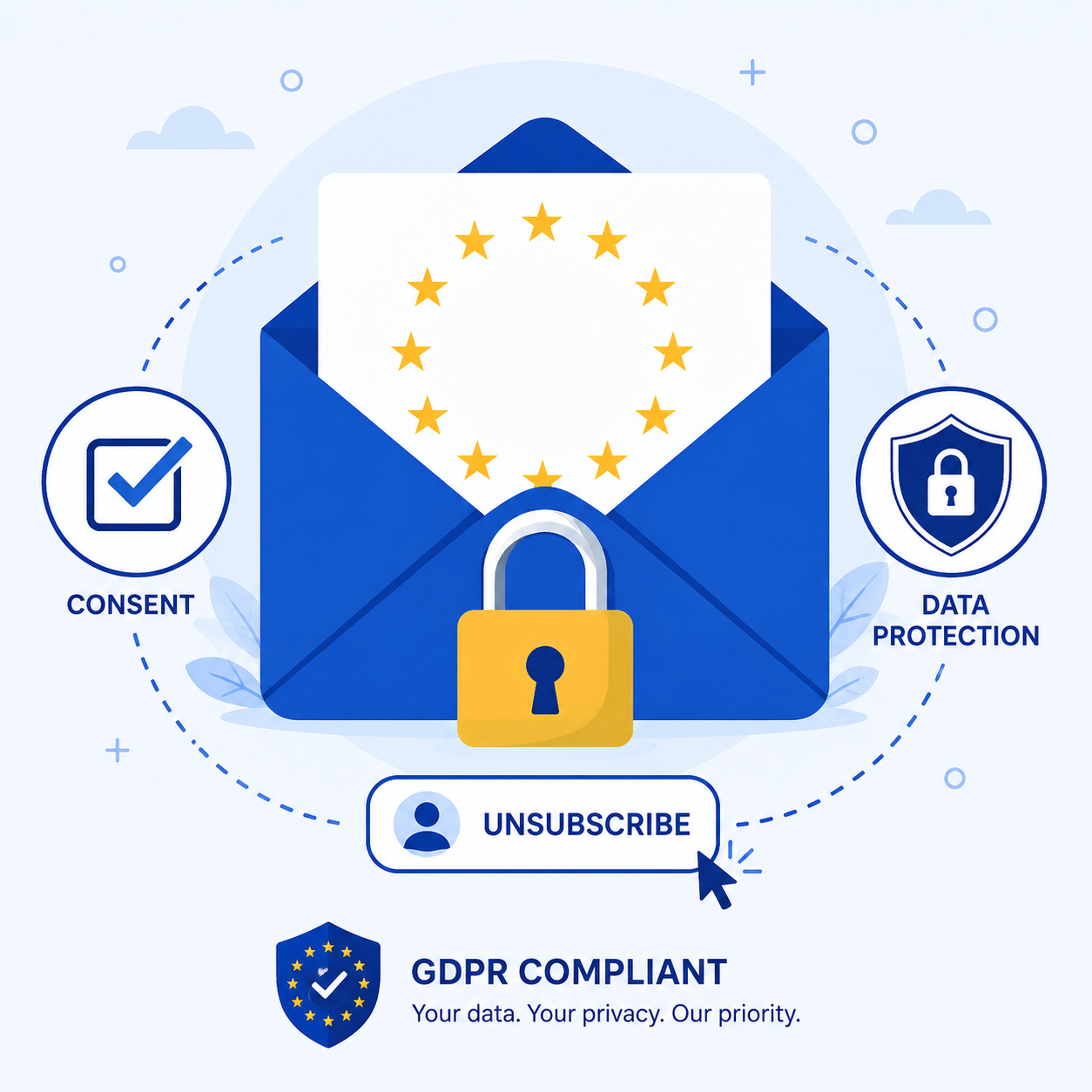

TL;DR: GDPR-compliant email marketing requires explicit, unambiguous consent (not pre-checked boxes), clear identification of your business, an easy and immediate unsubscribe option, and documented proof of how and when consent was given. Most email platforms (Mailchimp, Klaviyo, Brevo) include compliance tools, but the responsibility for actual compliance sits with you, not your software vendor.
Executive Summary
GDPR fines for email marketing violations are not theoretical — regulators across the EU have issued real penalties against businesses for purchased contact lists, pre-checked consent boxes, and failure to honor unsubscribe requests promptly. Fines can reach up to €20 million or 4% of global annual revenue, whichever is higher.
For any business marketing to EU residents — regardless of where your company is based — GDPR compliance in email marketing is not optional. This guide explains exactly what’s required, the most common compliance mistakes, and how to audit your current setup.
Who This Guide Is For
- Businesses marketing to customers or leads in the EU or UK
- Marketing teams unsure whether their current consent process is compliant
- Companies switching email platforms and rebuilding their opt-in process
- Anyone who has purchased or rented an email list and wants to understand the risk
Does GDPR Apply to Your Business?
GDPR applies if you process personal data of anyone located in the EU or UK, regardless of where your business is headquartered. This means a US-based ecommerce store selling to European customers is subject to GDPR for those customers’ data, even without a physical EU presence.
You are likely subject to GDPR if:
- You have customers or website visitors based in the EU/UK
- You collect email addresses through forms, checkout, or lead magnets
- You send any marketing communication to EU/UK-based contacts
The Core GDPR Requirements for Email Marketing
1. Lawful Basis for Processing
Before sending any marketing email, you need a lawful basis to process that person’s data. For marketing emails, this is almost always consent — though “legitimate interest” can sometimes apply to existing customers for similar products (this is a narrower exception and should be reviewed with legal counsel for your specific situation).
2. Explicit, Unambiguous Consent
Consent must be freely given, specific, informed, and unambiguous. This means:
- No pre-checked boxes — the user must actively check a box or take a clear action to opt in
- No bundled consent — you cannot require email marketing consent as a condition of an unrelated service or purchase
- Clear language — consent requests must state specifically what the person is signing up for, not vague language like “stay updated”
3. Double Opt-In (Recommended, Not Strictly Mandatory)
While GDPR doesn’t explicitly mandate double opt-in, it’s the strongest method of proving valid consent. The process:
- User submits their email via a signup form
- An automatic confirmation email is sent asking them to confirm
- Only after clicking confirm are they added to your active marketing list
This creates a clear, timestamped record that consent was genuinely given by the email owner — not someone else typing in their address.
4. Clear Identification
Every marketing email must clearly identify your business — legal name, physical address, and contact information — typically in the footer.
5. Easy, Immediate Unsubscribe
Every marketing email must include a clear, working unsubscribe link. Unsubscribe requests must be honored promptly — most guidance suggests within 10 business days, though best practice is immediate automated processing.
6. Documented Consent Records
You must be able to demonstrate, if asked by a regulator, exactly when and how consent was obtained for any given contact. This includes the timestamp, the specific form or source, and the exact consent language shown at the time.
7. Data Minimization
Only collect the data you actually need for your marketing purpose. Requesting excessive personal information during signup (date of birth, full address) without a clear business need increases your compliance risk.
8. Right to Erasure (“Right to Be Forgotten”)
Contacts can request complete deletion of their personal data, not just unsubscription from emails. Your systems need a process to fully remove a contact’s data across your CRM, email platform, and any connected tools — not just suppress future sends.
Common GDPR Mistakes in Email Marketing
| Mistake | Why It’s a Problem |
|---|---|
| Pre-checked consent checkboxes | Not considered valid “freely given” consent under GDPR |
| Buying or renting email lists | No valid consent exists for purchased contacts — high fine risk |
| Vague consent language (“get our updates”) | Fails the “specific and informed” consent requirement |
| No unsubscribe link, or a broken one | Direct violation, frequently triggers complaints to regulators |
| Treating all old contacts as still consented | Consent can become stale; long-inactive contacts should be re-confirmed or removed |
| No record of when/how consent was given | Cannot prove compliance if challenged by a regulator |
| Importing contacts from a CRM into email tool without verifying consent source | Easy way to accidentally email non-consented contacts |
GDPR Compliance by Email Platform
| Platform | Built-In Compliance Tools | Notes |
|---|---|---|
| Mailchimp | Double opt-in, consent timestamp logging, GDPR fields on forms | Strong out-of-box compliance tooling |
| Klaviyo | Double opt-in, consent tracking, EU data hosting option | Good for ecommerce-specific consent flows |
| Brevo | Built-in consent management, EU-based hosting | Strong choice for EU-focused businesses |
| ActiveCampaign | Double opt-in, GDPR fields, consent tracking | Solid compliance features across plans |
| HubSpot | GDPR-specific form fields, consent logging, legal basis tracking | Enterprise-grade compliance documentation tools |
Important: No platform makes you automatically compliant. These tools provide the mechanisms (double opt-in, consent logging) — but you are responsible for using them correctly, writing compliant consent language, and maintaining proper records.
GDPR vs. CCPA: Quick Note for US Businesses
If you market to both EU and California residents, note that GDPR and CCPA have different consent models. GDPR generally requires opt-in consent before marketing; CCPA is primarily opt-out based, focusing on the right to refuse data sale rather than requiring prior consent for marketing emails. Don’t assume CCPA compliance automatically satisfies GDPR requirements, or vice versa.
GDPR Compliance Audit Checklist
Run through this checklist on your current email marketing setup:
- Are all consent checkboxes unchecked by default?
- Does your consent language clearly state what the person is signing up for?
- Is double opt-in enabled, or do you have another strong method of proof?
- Does every email include your legal business name and address?
- Is the unsubscribe link visible and functional in every email?
- Can you pull a timestamped consent record for any individual contact if asked?
- Do you have a documented process for full data deletion requests, not just unsubscribes?
- Have you audited contacts imported from other systems to confirm valid consent source?
- Are you re-confirming consent for long-inactive contacts (12+ months with no engagement)?
- Do you have a designated person or process for handling data subject access requests?
What Happens If You’re Not Compliant
GDPR violations are enforced by national Data Protection Authorities (DPAs) across EU member states, often triggered by user complaints rather than proactive audits. Common outcomes for email marketing violations include:
- Formal warnings and corrective orders for first-time or minor violations
- Fines up to €20 million or 4% of global annual revenue, whichever is higher, for serious or repeated violations
- Reputational damage — regulatory actions are often publicly disclosed
Most enforcement actions against smaller businesses start with a complaint-triggered investigation and a corrective order rather than an immediate maximum fine — but the financial exposure exists and increases with repeated or willful non-compliance.
Frequently Asked Questions
Do I need GDPR compliance if my business isn’t based in the EU?
Yes, if you market to individuals located in the EU or UK, GDPR applies regardless of where your business is headquartered.
Is double opt-in legally required under GDPR?
Not explicitly required by the text of GDPR, but it’s widely recommended as the strongest practical method to prove valid, unambiguous consent i