
TL;DR: HubSpot offers the most accessible lead scoring for small-to-mid businesses already using its CRM, with both rule-based and AI-powered predictive scoring available depending on tier. Marketo (Adobe) remains the most sophisticated option for complex B2B enterprises with long sales cycles. Zoho CRM’s Zia AI offers solid predictive scoring at a fraction of enterprise pricing. Below, we compare 7 platforms by scoring methodology, CRM integration, and pricing.
Executive Summary
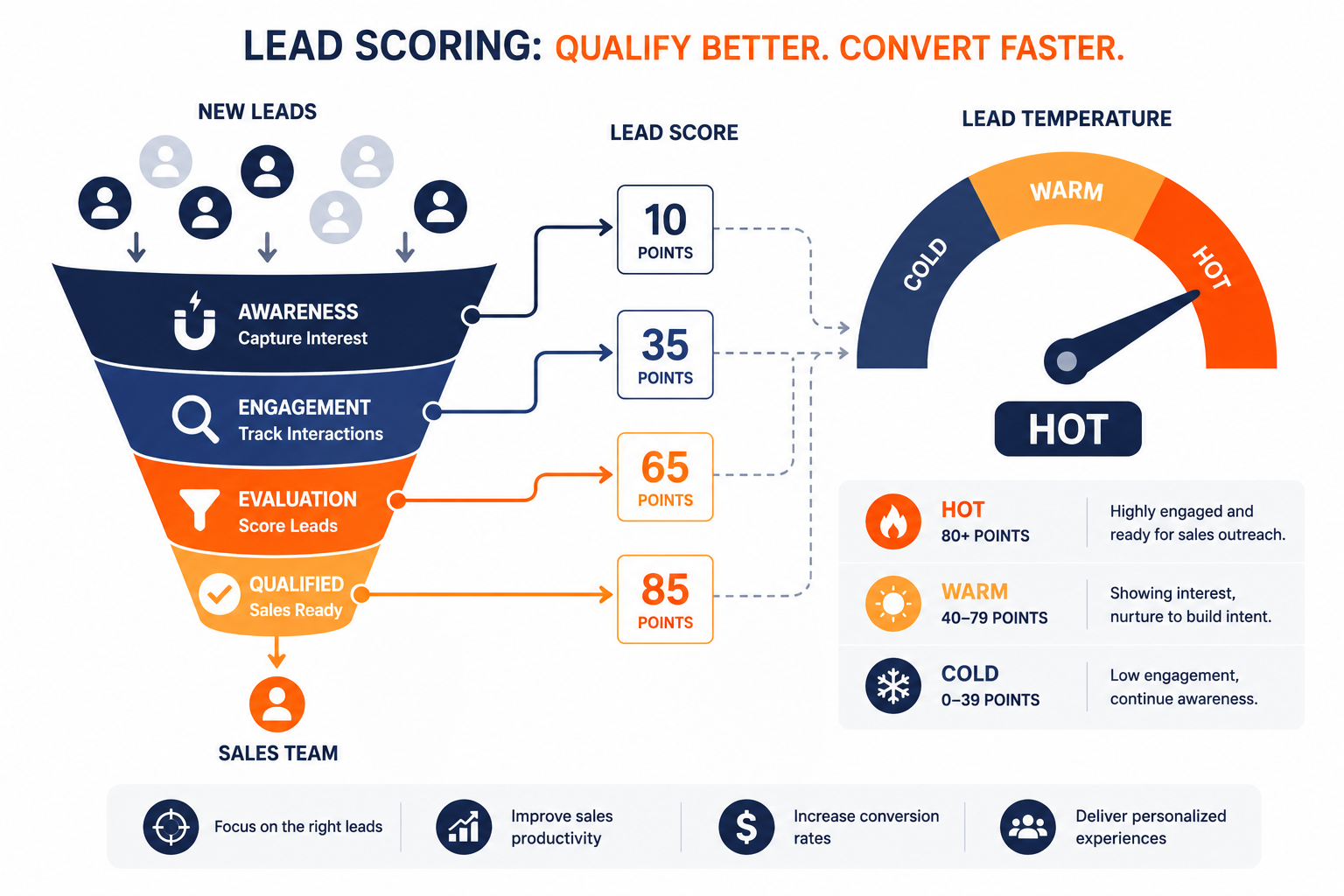
Sales teams waste significant time chasing leads that were never going to convert, while genuinely sales-ready leads sometimes sit unworked because nothing flagged their readiness. Lead scoring software solves this by assigning a quantifiable score to each lead based on behavior and demographic fit, helping sales teams prioritize outreach toward the leads most likely to close.
This guide compares the seven leading lead scoring platforms in 2026, covering both rule-based and AI-driven predictive approaches.
Who This Guide Is For
- B2B sales and marketing teams wanting to prioritize lead follow-up systematically
- Businesses currently treating all leads equally regardless of engagement or fit
- Companies evaluating whether to upgrade from basic CRM lead tracking to dedicated scoring
- Marketing operations teams building lead handoff processes between marketing and sales
Rule-Based vs. AI-Driven Predictive Scoring
| Approach | How It Works | Best For |
|---|---|---|
| Rule-based scoring | Manually assigned point values for specific actions (email open = 5 points, demo request = 25 points) | Businesses with clear, well-understood buying signals |
| AI/predictive scoring | Machine learning analyzes historical closed-won/lost data to identify patterns predicting conversion | Businesses with sufficient historical data and less obvious buying signal patterns |
Practical reality: Most platforms now offer some combination of both, allowing manual rule adjustments alongside AI-suggested refinements based on actual conversion outcomes.
Quick Comparison Table
| Platform | Starting Price | Scoring Type | Best For |
|---|---|---|---|
| HubSpot | $20/user/month (Starter); AI scoring on Pro+ | Rule-based + AI (Pro tier) | Most accessible for SMB-to-mid market |
| Marketo (Adobe) | Custom (typically $1,000+/month) | Advanced AI predictive | Complex enterprise B2B |
| Zoho CRM (Zia AI) | $40/user/month (Enterprise) | AI predictive | Affordable predictive scoring |
| ActiveCampaign | $29/month | Rule-based | Small business automation-tied scoring |
| Salesforce Einstein | Requires Sales Cloud + add-on | Advanced AI predictive | Salesforce-native enterprises |
| Pardot (Marketing Cloud Account Engagement) | Custom (typically $1,250+/month) | Rule-based + AI | B2B enterprises in Salesforce ecosystem |
| Infer (now part of Demandbase) | Custom enterprise pricing | Advanced AI predictive | Account-based marketing-focused B2B |
HubSpot — Most Accessible
HubSpot offers lead scoring across a range of tiers, from basic rule-based scoring on lower plans to genuine AI-powered predictive scoring on Professional and Enterprise.
Strengths:
- Scoring integrates natively with the same CRM your sales team already uses
- AI-powered predictive scoring available on Professional tier, factoring in both demographic fit and engagement behavior
- Clear visual scoring rules that non-technical marketing teams can configure and adjust
Limitations:
- Genuine predictive AI scoring requires Marketing Hub Professional, a meaningful price jump from Starter
- Less sophisticated than purpose-built enterprise predictive platforms for very complex B2B sales cycles
Pricing: Starter from $20/user/month; AI-powered scoring requires Professional tier (~$890/month).
Best for: Small-to-mid businesses already using or considering HubSpot’s broader CRM and marketing platform.
(See our HubSpot Pricing Explained guide for full tier detail.)
Marketo (Adobe) — Best for Complex Enterprise B2B
Marketo remains one of the most sophisticated lead scoring platforms, particularly suited to enterprises with long, complex B2B sales cycles involving multiple stakeholders.
Strengths:
- Highly sophisticated multi-dimensional scoring accounting for both individual lead behavior and broader account-level signals
- Strong integration with Salesforce and other enterprise CRM platforms
- Deep customization for complex, multi-touch B2B buying journeys
Limitations:
- Significant cost, generally inaccessible for small-to-mid businesses
- Steep learning curve requiring dedicated marketing operations expertise
Pricing: Custom enterprise pricing, typically starting well over $1,000/month.
Best for: Large enterprises with complex, multi-stakeholder B2B sales cycles and dedicated marketing operations resources.
Zoho CRM (Zia AI) — Best Affordable Predictive Option
Zoho’s Zia AI assistant brings genuine predictive lead scoring to a price point dramatically below Marketo or Salesforce Einstein.
Strengths:
- AI-driven scoring analyzes historical conversion patterns at a fraction of enterprise platform cost
- Integrated directly within Zoho CRM, requiring no separate scoring tool or integration
- Reasonable customization for businesses with moderate, not extreme, sales complexity
Limitations:
- Less sophisticated than dedicated enterprise predictive platforms for very complex sales cycles
- Requires Zoho CRM Enterprise tier to access Zia AI features
Pricing: Zia AI scoring available on Zoho CRM Enterprise, starting at $40/user/month.
Best for: Small-to-mid businesses wanting genuine AI predictive scoring without enterprise-level pricing.
(See our Zoho CRM vs Salesforce Essentials comparison for broader platform context.)
ActiveCampaign — Best for Automation-Tied Scoring
ActiveCampaign ties lead scoring directly into its broader automation engine, allowing scores to trigger specific follow-up sequences automatically.
Strengths:
- Scoring directly triggers automated workflows, not just passive reporting
- Affordable for small businesses compared to enterprise-tier predictive platforms
- Flexible rule configuration for businesses with clear, identifiable buying signals
Limitations:
- Rule-based only, without genuine AI predictive modeling
- Less suited to complex B2B sales cycles with many stakeholders
Pricing: Starts at $29/month.
Best for: Small businesses wanting lead scores to directly trigger automated sales and marketing actions.
Salesforce Einstein — Best for Salesforce-Native Enterprises
Einstein brings AI-powered predictive scoring directly into the Salesforce ecosystem for businesses already standardized on that platform.
Strengths:
- Deep native integration with Salesforce CRM data and workflows
- Sophisticated predictive modeling based on extensive historical Salesforce data
- Scales well for large sales organizations with substantial historical conversion data
Limitations:
- Requires existing Salesforce Sales Cloud investment plus additional Einstein licensing
- Significant cost when layered on top of Salesforce’s existing pricing
Pricing: Add-on pricing on top of Salesforce Sales Cloud subscription, typically requiring a sales conversation.
Best for: Enterprises already standardized on Salesforce wanting native AI predictive scoring.
Pardot / Marketing Cloud Account Engagement — Best for Salesforce B2B Marketing
Pardot (now branded Marketing Cloud Account Engagement) offers sophisticated B2B-focused scoring deeply integrated with Salesforce.
Strengths:
- Strong grading and scoring combination — separately tracking fit (grading) and engagement (scoring)
- Deep integration with Salesforce for unified sales and marketing data
- Mature platform with extensive B2B-specific automation capability
Limitations:
- Significant cost, positioned for established B2B enterprises
- Implementation typically requires dedicated marketing operations expertise
Pricing: Custom, typically starting at $1,250+/month.
Best for: Established B2B enterprises in the Salesforce ecosystem with dedicated marketing operations support.
Infer (Demandbase) — Best for Account-Based Marketing
Infer specializes in predictive scoring specifically tailored to account-based marketing (ABM) strategies, scoring at the account level rather than just individual lead level.
Strengths:
- Account-level predictive scoring particularly suited to ABM strategies
- Strong fit-based scoring using firmographic and technographic data
- Integrates with major CRM and marketing automation platforms
Limitations:
- Custom enterprise pricing, generally inaccessible for small businesses
- Most valuable specifically for businesses running formal ABM programs
Pricing: Custom enterprise pricing.
Best for: B2B enterprises running account-based marketing strategies needing account-level predictive scoring.
How to Choose the Right Lead Scoring Platform
If you want the most accessible entry point: HubSpot.
If you need sophisticated enterprise-grade predictive modeling: Marketo.
If you want affordable AI predictive scoring: Zoho CRM with Zia AI.
If you want scores to directly trigger automation: ActiveCampaign.
If you’re already standardized on Salesforce: Salesforce Einstein or Pardot.
If you run account-based marketing specifically: Infer.
Building Effective Lead Scoring Criteria
Regardless of platform, effective scoring models typically weigh:
- Demographic/firmographic fit — company size, industry, job title matching your ideal customer profile
- Engagement behavior — email opens, website visits, content downloads, demo requests
- Negative scoring signals — unsubscribes, invalid information, signals indicating poor fit (competitor domains, student email addresses for B2B)
- Recency weighting — recent engagement should typically score higher than older activity, since interest often fades over time
Frequently Asked Questions
Is lead scoring worth implementing for a small sales team?
Yes, even small teams benefit from prioritization, since it ensures limited sales capacity focuses on the highest-probability leads rather than working through lists in arbitrary order.
What’s the difference between lead scoring and lead grading?
Scoring typically measures engagement and behavior (how interested is this lead), while grading measures fit (how well does this lead match your ideal customer profile) — the strongest systems combine both dimensions.
How much historical data do I need for AI predictive scoring to work well?
Generally, several hundred to a few thousand closed-won and closed-lost records provide enough pattern data for meaningful predictive accuracy — businesses with very limited historical data may see more value from rule-based scoring initially.
Can I switch from rule-based to AI-driven scoring later?
Yes, most platforms supporting both approaches allow you to start with rule-based scoring and transition to AI-driven scoring once you’ve accumulated sufficient historical conversion data.
Does lead scoring replace the need for sales judgment?
No, scoring should inform prioritization, not replace sales judgment entirely — a well-scored lead still requires genuine qualification conversation before assuming it’s truly sales-ready.
Is Marketo overkill for a small B2B business?
Generally yes, unless you have a genuinely complex, multi-stakeholder sales cycle and dedicated marketing operations resources to manage the platform’s complexity.
How often should lead scoring criteria be reviewed and adjusted?
Review scoring criteria at least quarterly, comparing actual conversion outcomes against scores assigned, adjusting weights for signals that prove more or less predictive than initially assumed.
Do I need a separate lead scoring tool, or is my CRM’s built-in scoring enough?
For straightforward B2B sales processes, built-in CRM scoring (HubSpot, Zoho) is often sufficient. Dedicated standalone tools like Infer become more valuable for sophisticated account-based marketing strategies.
Final Verdict
For most small-to-mid businesses, HubSpot offers the most accessible path to genuine lead scoring, particularly if you’re already using or considering its CRM. Businesses wanting affordable AI-driven predictive scoring without enterprise pricing should strongly consider Zoho CRM’s Zia AI, while complex B2B enterprises with substantial sales operations resources are better served by Marketo’s sophisticated, if costly, predictive capabilities.
Whichever platform you choose, remember that lead scoring is only as good as the criteria behind it — invest time in defining and regularly refining your scoring rules based on actual conversion outcomes, not just the platform’s default settings.
Pricing reflects publicly available rates as of mid-2026 and may change. Verify current pricing directly with each vendor.