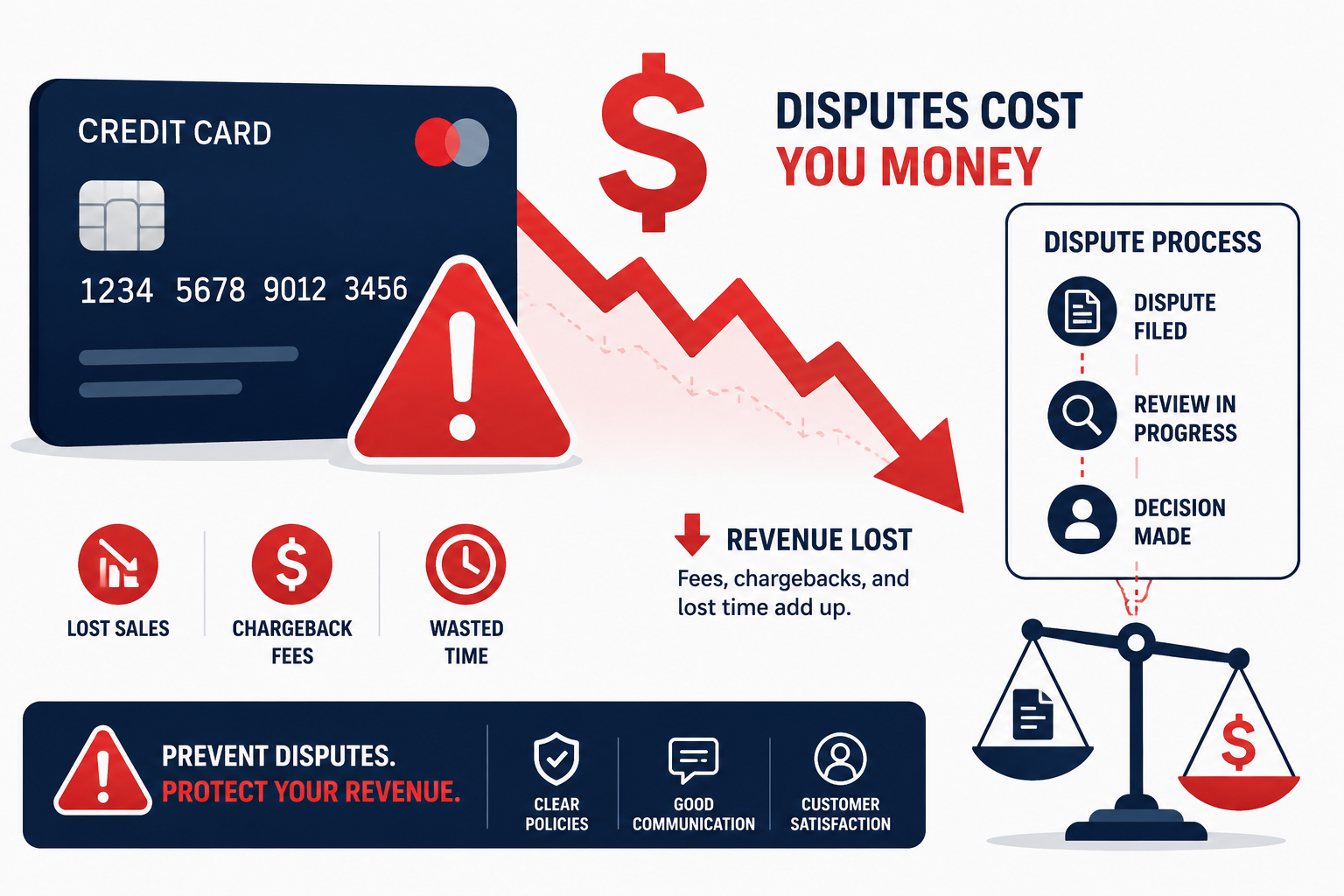

TL;DR: A single chargeback typically costs a small business 2-3 times the original transaction value once you account for the dispute fee ($15-25), the lost merchandise or service, and the lost revenue itself. Beyond individual transactions, exceeding chargeback ratio thresholds (generally 0.65-1% of transactions) can trigger high-risk merchant status, dramatically increasing processing fees or resulting in account termination. Below, we break down the full cost and proven prevention strategies.
Executive Summary
A chargeback looks like a single line item on a statement, but its true cost extends well beyond the disputed transaction amount. Between dispute fees, lost goods or services, administrative time, and the compounding risk of merchant account penalties, chargebacks represent one of the most underestimated cost categories for small businesses accepting card payments.
This guide breaks down every cost component and the prevention strategies that meaningfully reduce dispute frequency.
Who This Guide Is For
- Ecommerce business owners experiencing chargeback disputes
- Service businesses accepting card payments for deposits or recurring billing
- Businesses approaching or exceeding chargeback ratio thresholds with their payment processor
- Anyone wanting to understand the full financial impact before it becomes a problem
The Direct Costs of a Single Chargeback
1. The Dispute Fee
Most payment processors charge $15-25 per chargeback, regardless of whether you ultimately win or lose the dispute. This fee compensates the processor for handling the dispute investigation, not for the disputed amount itself.
2. The Original Transaction Amount
If you lose the dispute, the full transaction amount is deducted from your account and returned to the customer — on top of the dispute fee you already paid.
3. Lost Merchandise or Service Delivery
For physical goods, you’ve typically already shipped the product, meaning you lose both the payment and the merchandise. For services already rendered, the lost time and resources represent a similar sunk cost.
4. Administrative Time
Responding to a chargeback dispute requires gathering evidence (receipts, delivery confirmation, communication records) and submitting a formal response — typically 1-3 hours of staff time per dispute, even for businesses that ultimately win.
Real Cost Example: $75 Transaction Chargeback
| Cost Component | Amount |
|---|---|
| Dispute fee | $20 |
| Lost transaction amount (if dispute is lost) | $75 |
| Lost merchandise cost (assume 40% margin) | $30 |
| Administrative time (1.5 hours @ $25/hour) | $37.50 |
| Total real cost | ~$162.50 |
This represents over double the original $75 transaction value — and this calculation doesn’t even include the potential impact on your merchant account standing if disputes become frequent.
The Compounding Risk: Chargeback Ratio Penalties
Payment processors and card networks monitor your chargeback ratio — the percentage of transactions resulting in a dispute — and impose escalating consequences as it rises.
| Chargeback Ratio | Typical Consequence |
|---|---|
| Under 0.65% | Generally considered acceptable |
| 0.65%–1% | Increased monitoring, possible warning notices |
| 1%–2% | High-risk merchant classification, increased processing fees |
| Over 2% | Account termination risk, placement on industry monitoring programs (MATCH list) |
Critical detail: Being placed on the MATCH list (Mastercard’s merchant monitoring program) can make it extremely difficult to obtain a new merchant account with any provider for years afterward — a consequence that extends far beyond the immediate dispute costs.
Common Causes of Chargebacks
1. Genuine Fraud
A stolen card was used to make the purchase, and the actual cardholder disputes a transaction they never authorized.
2. Friendly Fraud
The cardholder made the purchase but disputes it anyway — claiming non-receipt, dissatisfaction, or simply not recognizing the charge — without first contacting the merchant for resolution. This category has grown significantly and is often difficult to definitively prove or disprove.
3. Processing Errors
Duplicate charges, incorrect amounts, or billing errors that customers dispute legitimately because the charge itself was wrong.
4. Product or Service Dissatisfaction
Customers who are unhappy with a purchase and choose to dispute rather than request a refund directly through the merchant.
5. Subscription/Recurring Billing Confusion
Customers who forgot about a recurring charge or didn’t successfully cancel before a renewal, disputing instead of contacting the business first.
Chargeback Prevention Strategies
1. Make Refunds Easy and Visible
Customers who can easily request a refund directly are less likely to file a dispute instead. A visible, simple refund process redirects many “friendly fraud” disputes back into manageable refund requests.
2. Use Clear Billing Descriptors
Ensure your business name appears recognizably on customer statements. Confusing or unrecognizable billing descriptors are a leading cause of legitimate confusion-based disputes.
3. Send Order and Shipping Confirmations Proactively
Clear confirmation emails with tracking information reduce “item not received” disputes and provide evidence if a dispute does occur.
4. Implement Address Verification (AVS) and CVV Checks
These standard fraud prevention tools catch a meaningful percentage of fraudulent transactions before they’re even processed, preventing the resulting chargeback entirely.
5. Use 3D Secure for Online Transactions
This additional authentication layer (often appearing as a redirect to verify with your bank) shifts liability for certain fraud-related chargebacks away from the merchant in many cases.
6. Communicate Clearly Before Recurring Charges
Send renewal reminders before subscription charges process, giving customers the opportunity to cancel proactively rather than disputing after the fact.
7. Respond to Every Dispute With Evidence
Even disputes you expect to lose should be contested with available evidence (delivery confirmation, communication logs) where reasonable — this protects your dispute response rate, which processors also monitor.
Chargeback Management Tools
For businesses experiencing chargebacks regularly, dedicated tools can help manage the process and prevent future disputes:
| Tool Type | Purpose |
|---|---|
| Chargeback alert services (Ethoca, Verifi) | Notify you of a pending dispute before it formally processes, allowing proactive refund to avoid the chargeback entirely |
| Dispute response automation (Chargeflow, Justt) | Automate evidence gathering and dispute response submission |
| Fraud screening tools (Signifyd, Riskified) | Screen transactions in real-time to flag likely fraudulent orders before processing |
Why alert services matter specifically: Catching a dispute at the alert stage and issuing a refund proactively avoids the chargeback itself — meaning no dispute fee, no ratio impact, and often a better outcome for both parties than a formal dispute process.
When to Fight vs. Accept a Chargeback
Fight the dispute when:
- You have clear evidence of delivery (tracking, signature confirmation)
- Communication records show the customer’s complaint was already addressed
- The transaction shows clear legitimate authorization (matching billing address, successful prior transactions from the same customer)
Consider accepting when:
- The transaction amount is small relative to the time cost of fighting it
- Evidence is genuinely weak or unavailable
- The customer relationship has long-term value worth preserving despite the dispute
Frequently Asked Questions
How much does a typical chargeback actually cost a small business?
Accounting for the dispute fee, lost merchandise, and administrative time, a chargeback commonly costs 2-3 times the original transaction value, even before considering ratio-related risks.
What is considered a dangerous chargeback ratio?
Generally, ratios above 1% start triggering high-risk classification and increased fees, with most card networks setting formal thresholds around 0.65-1% depending on the specific program.
Can I prevent friendly fraud chargebacks?
Not entirely, but making refunds easy to request, sending clear billing descriptors, and maintaining thorough transaction documentation reduces both the frequency and your success rate in disputing them.
Is it worth paying for chargeback alert services?
For businesses with consistent dispute volume, yes — proactively refunding before a formal chargeback often costs less than the combined dispute fee and ratio impact of a formal dispute.
What happens if I get placed on the MATCH list?
You’ll find it extremely difficult to obtain a new merchant account with most providers for a period of time (commonly several years), as the list is shared across the payment processing industry to flag high-risk merchants.
Should I always fight chargebacks, even small ones?
Not necessarily — weigh the administrative time cost against the transaction value. For very small transactions, the cost of fighting may exceed the value of winning.
Does 3D Secure guarantee I won’t be liable for fraud-related chargebacks?
No, but it shifts liability in many cases for transactions properly authenticated through the protocol, reducing your exposure to certain categories of fraud-related disputes.
How long do I have to respond to a chargeback dispute?
This varies by card network and processor but is typically 7-21 days from notification. Missing the response window typically results in an automatic loss of the dispute.
Final Verdict
The advertised dispute fee represents only a fraction of a chargeback’s true cost once lost merchandise, administrative time, and potential ratio penalties are factored in. For businesses experiencing chargebacks regularly, investing in prevention — clear billing descriptors, easy refund processes, AVS/CVV verification, and potentially a chargeback alert service — typically costs far less than the cumulative impact of unmanaged disputes.
Monitor your chargeback ratio proactively rather than reactively; by the time you’re notified of a ratio violation by your processor, the damage to your merchant account standing may already be difficult to reverse.
This guide provides general informational content as of mid-2026. Specific chargeback policies, fees, and thresholds vary by payment processor and card network — verify current terms directly with your provider.