
TL;DR: QuickBooks Online is the best overall Xero alternative for most small businesses, offering broader accountant familiarity and a larger app ecosystem. Wave is the strongest free option for very small businesses and freelancers. Zoho Books wins if you want deep integration with a broader affordable business suite. Below, we compare 8 platforms by pricing, features, and migration ease.
Executive Summary
Xero is a capable accounting platform, but it’s not the right fit for every business. Some users find its inventory management too limited for retail or product-based businesses. Others want deeper integration with a broader business suite (CRM, invoicing, payroll) beyond pure accounting. And some are simply looking for a free or lower-cost option while bootstrapping.
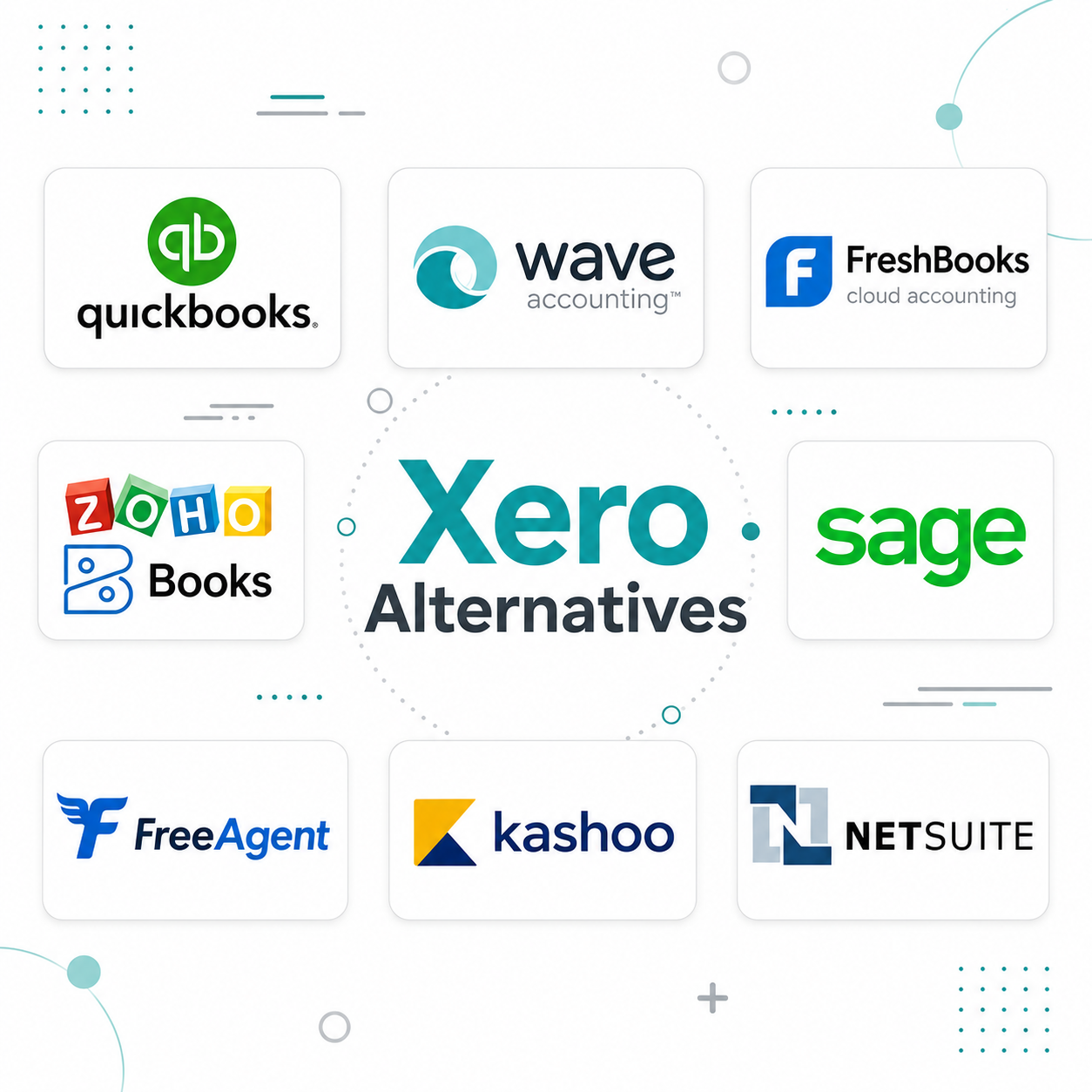
This guide compares the eight strongest Xero alternatives in 2026, with honest assessment of where each wins and where Xero might still be the better choice.
Who This Guide Is For
- Small business owners evaluating accounting software options
- Current Xero users considering a switch
- Freelancers and very small businesses wanting free or low-cost options
- Businesses needing stronger inventory or industry-specific features than Xero offers
Why Businesses Look for Xero Alternatives
- Limited inventory management for product-based or retail businesses
- Pricing increases as you need more advanced features or additional users
- Wanting tighter integration with a broader business suite beyond accounting alone
- Accountant/bookkeeper familiarity — many accounting professionals default to QuickBooks
- Industry-specific needs not well served by Xero’s general-purpose feature set
Quick Comparison Table
| Platform | Starting Price | Free Tier | Best For |
|---|---|---|---|
| QuickBooks Online | $35/month | No | Most widely supported by accountants |
| Wave | Free (paid add-ons) | Yes | Freelancers and very small businesses |
| FreshBooks | $21/month | No | Service-based businesses and freelancers |
| Zoho Books | $20/month (often free for very small biz) | Yes (limited) | Integration with Zoho ecosystem |
| Sage Business Cloud | $25/month | No | Established businesses, strong reporting |
| FreeAgent | $19/month | No | UK-based freelancers and contractors |
| Kashoo | $20/month | No | Simple, minimalist bookkeeping |
| NetSuite | Custom pricing | No | Larger businesses needing ERP-level features |
QuickBooks Online — Best Overall Alternative
QuickBooks remains the most widely used small business accounting platform, with the broadest accountant and bookkeeper familiarity of any option on this list.
Strengths:
- Most accountants and bookkeepers are already trained on QuickBooks, simplifying professional support
- Strong inventory management on higher tiers
- Extensive third-party app integration ecosystem
- Robust mobile app for invoicing and expense tracking on the go
Limitations:
- Pricing increases meaningfully as you move up tiers for advanced features
- Customer support quality has drawn criticism compared to smaller competitors
Pricing: Starts at $35/month (Simple Start).
Best for: Businesses wanting the most broadly supported platform among accounting professionals.
(For a detailed comparison, see our QuickBooks vs Xero guide.)
Wave — Best Free Option
Wave offers genuinely free accounting and invoicing, monetizing instead through optional payment processing and payroll add-ons.
Strengths:
- Core accounting and invoicing features are completely free
- Clean, modern interface despite the free price point
- Payment processing and payroll available as paid add-ons if needed
Limitations:
- Customer support is limited, particularly on the free tier
- Lacks advanced features needed by growing or more complex businesses
Pricing: Free for core accounting; payment processing and payroll are paid add-ons.
Best for: Freelancers, solopreneurs, and very small businesses wanting genuinely free accounting software.
FreshBooks — Best for Service-Based Businesses
FreshBooks emphasizes invoicing and time tracking, making it particularly well suited to service-based businesses and freelancers who bill by the hour.
Strengths:
- Excellent invoicing interface with professional, customizable templates
- Strong built-in time tracking for hourly billing
- Simple, approachable interface for non-accountants
Limitations:
- Inventory management is minimal, unsuitable for product-based businesses
- Advanced accounting features are more limited than QuickBooks or Xero
Pricing: Starts at $21/month.
Best for: Freelancers and service businesses prioritizing invoicing and time tracking over complex accounting needs.
Zoho Books — Best for Zoho Ecosystem Integration
Zoho Books integrates natively with Zoho’s broader business suite, appealing to businesses already using Zoho CRM or other Zoho products.
Strengths:
- Free tier available for very small businesses (under a revenue threshold)
- Tight integration with Zoho CRM, Inventory, and other Zoho products
- Affordable pricing relative to feature depth
Limitations:
- Smaller third-party integration ecosystem outside of Zoho’s own products
- Less accountant familiarity compared to QuickBooks or Xero
Pricing: Free for businesses under a specific revenue threshold; paid plans start at $20/month.
Best for: Businesses already using or planning to adopt Zoho’s broader business suite.
Sage Business Cloud — Best for Established Businesses
Sage has a long history in business accounting software, with particularly strong reporting capabilities for established small-to-mid-size businesses.
Strengths:
- Strong, detailed financial reporting capabilities
- Good multi-currency and international business support
- Established reputation among accounting professionals, particularly outside the US
Limitations:
- Interface feels less modern than newer competitors
- Some advanced features require higher-tier plans
Pricing: Starts at $25/month.
Best for: Established businesses, particularly those with international operations, wanting robust reporting.
FreeAgent — Best for UK Freelancers and Contractors
FreeAgent is particularly popular among UK-based freelancers and contractors, with strong support for UK-specific tax requirements.
Strengths:
- Strong UK tax compliance features (Self Assessment, VAT)
- Free for UK business banking customers with certain banks
- Clean, simple interface for non-accountants
Limitations:
- Less relevant for businesses outside the UK
- Smaller feature set compared to QuickBooks or Xero for complex needs
Pricing: Starts at $19/month (often free for UK business banking customers with partner banks).
Best for: UK-based freelancers and contractors wanting strong local tax compliance support.
Kashoo — Best Minimalist Option
Kashoo strips bookkeeping down to its essentials, appealing to small business owners who want simplicity over feature breadth.
Strengths:
- Simple, clean interface with minimal learning curve
- Affordable pricing for basic bookkeeping needs
- Decent mobile app for expense tracking and invoicing
Limitations:
- Lacks advanced features needed by growing or more complex businesses
- Smaller integration ecosystem than larger competitors
Pricing: Starts at $20/month.
Best for: Very small businesses wanting straightforward bookkeeping without complexity.
NetSuite — Best for Larger Businesses Needing ERP
NetSuite is positioned well above typical small business accounting software, offering full ERP capabilities for businesses outgrowing standard accounting platforms.
Strengths:
- Full ERP capabilities including advanced inventory, supply chain, and financial planning
- Highly customizable for complex, multi-entity businesses
- Strong reporting and business intelligence tools
Limitations:
- Significantly more expensive than standard small business accounting software
- Requires dedicated implementation support and longer setup time
Pricing: Custom pricing, typically starting in the thousands annually.
Best for: Growing businesses that have outgrown standard small business accounting and need full ERP functionality.
How to Choose the Right Xero Alternative
If you want the most broadly supported platform: QuickBooks Online.
If you want genuinely free accounting: Wave.
If you’re a service-based freelancer billing by time: FreshBooks.
If you’re invested in the Zoho ecosystem: Zoho Books.
If you need strong reporting for an established business: Sage Business Cloud.
If you’re a UK freelancer: FreeAgent.
If you want minimalist bookkeeping: Kashoo.
If you’ve outgrown standard small business accounting: NetSuite.
Migration Checklist: Switching from Xero
- Export your chart of accounts and historical transactions before canceling your Xero subscription
- Reconcile your books fully in Xero before migrating, to ensure a clean starting balance in the new platform
- Notify your accountant or bookkeeper early, since they may have a strong preference or specific migration process
- Run a parallel period if possible, recording transactions in both systems briefly to verify accuracy
- Migrate historical data conservatively — you may not need years of detailed transaction history in the new system if annual summaries suffice for tax purposes
Frequently Asked Questions
What is the cheapest Xero alternative?
Wave is the cheapest, offering genuinely free core accounting and invoicing, monetizing only through optional payment processing and payroll services.
Which alternative is most similar to Xero in features?
QuickBooks Online and Zoho Books both offer comparable double-entry accounting depth to Xero, with QuickBooks having broader accountant familiarity.
Can I import my Xero data into a new accounting platform?
Most platforms support CSV import for charts of accounts and transactions, though direct one-click migration tools vary by destination platform. Some complex data may require manual re-entry or accountant assistance.
Is Wave actually free, or are there hidden costs?
Core accounting and invoicing are genuinely free. Wave generates revenue through optional payment processing fees and a paid payroll add-on, not through hidden accounting software fees.
Which platform has the best inventory management among Xero alternatives?
QuickBooks Online offers the strongest inventory management among the platforms in this comparison, particularly on its higher tiers.
Should I switch accounting software mid-fiscal-year?
It’s possible but adds complexity to your annual reporting. Most accountants recommend switching at the start of a new fiscal year or quarter when feasible.
Will switching accounting platforms affect my tax filing?
Not directly, as long as your historical records are accurately migrated or archived for reference. Work with your accountant to ensure continuity for tax preparation purposes.
Is NetSuite overkill for a small business?
Generally yes, unless you have complex multi-entity, multi-currency, or supply chain needs that standard small business accounting software can’t handle. Most small businesses are better served by QuickBooks, Xero, or Zoho Books.
Final Verdict
For most small businesses considering a move away from Xero, QuickBooks Online offers the strongest combination of features and professional support familiarity. Budget-conscious freelancers and very small businesses should strongly consider Wave for its genuinely free core functionality, while businesses already using Zoho’s broader suite will find the tightest integration with Zoho Books.
Whichever platform you choose, prioritize a clean migration with fully reconciled books before switching — accounting data integrity matters far more during a platform change than any specific feature comparison.
Pricing reflects publicly available rates as of mid-2026 and may vary by region and promotion. Verify current pricing directly with each vendor.