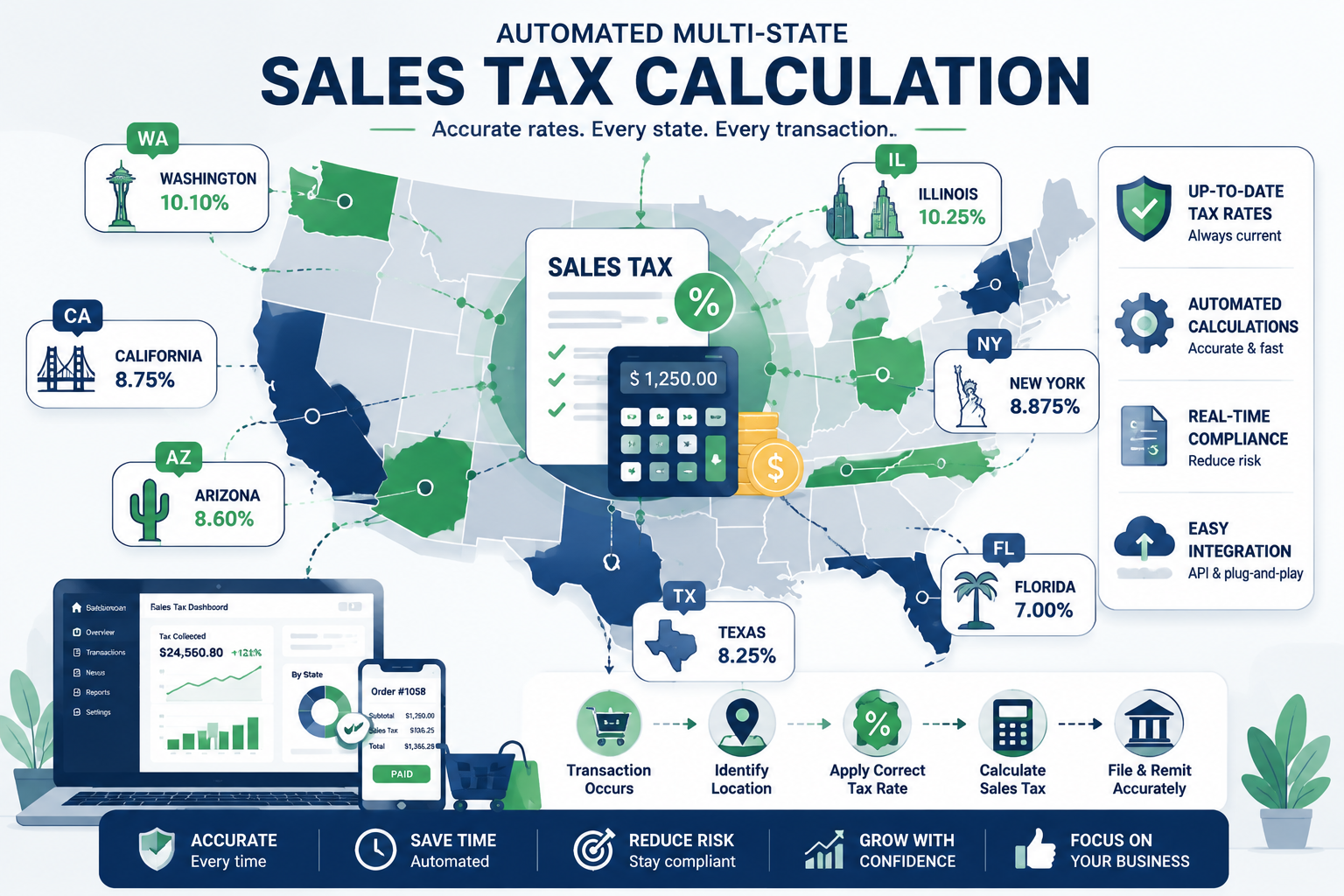

TL;DR: Avalara remains the most comprehensive sales tax automation platform, particularly suited to businesses with complex multi-state nexus and high transaction volume. TaxJar offers the best balance of features and accessibility for small-to-mid ecommerce businesses, with strong Shopify and Amazon integration. Quaderno specializes in international/EU VAT compliance alongside US sales tax. Below, we compare 7 platforms by nexus tracking, automatic filing, and pricing.
Executive Summary
Sales tax compliance for ecommerce businesses became significantly more complex after the 2018 Wayfair Supreme Court decision, which allowed states to require tax collection based on economic nexus (sales volume or transaction count) rather than just physical presence. This means even businesses without a physical location in a state may now owe sales tax collection obligations there once they cross that state’s specific economic threshold.
This guide compares the seven leading sales tax automation platforms helping ecommerce businesses navigate this complexity in 2026.
Who This Guide Is For
- Ecommerce businesses selling across multiple states needing nexus tracking
- Shopify, WooCommerce, or Amazon sellers wanting automated tax calculation and filing
- Businesses that have crossed economic nexus thresholds in new states
- Companies expanding internationally and needing VAT/GST compliance alongside US sales tax
Understanding Economic Nexus
Since the 2018 Wayfair decision, most states impose economic nexus thresholds — typically based on annual sales revenue or transaction count within that state — that trigger a sales tax collection obligation even without physical presence.
| Typical Threshold Pattern | Common Range |
|---|---|
| Revenue-based threshold | $100,000-$500,000 in annual sales to that state |
| Transaction-based threshold | 200+ transactions to that state (used by some states alongside or instead of revenue threshold) |
Critical detail: Thresholds vary by state, and many states have eliminated the transaction-count threshold in recent years, relying solely on revenue thresholds — always verify current requirements for each state where you have meaningful sales volume.
Quick Comparison Table
| Platform | Starting Price | Automatic Filing | Best For |
|---|---|---|---|
| Avalara | Custom (typically $50+/month) | Yes | Most comprehensive, complex multi-state needs |
| TaxJar | $19/month | Yes | Best balance for small-to-mid ecommerce |
| Quaderno | $49/month | Yes | International VAT/GST plus US sales tax |
| Vertex | Custom enterprise pricing | Yes | Large enterprise tax compliance |
| Sovos | Custom enterprise pricing | Yes | Enterprise compliance across multiple tax types |
| Numeral | $250/month | Yes | Modern, ecommerce-focused automation |
| Shopify Tax (native) | Included in Shopify plan, with transaction fees | No (calculation only, filing separate) | Basic Shopify-native calculation |
Avalara — Most Comprehensive
Avalara offers the deepest sales tax automation capability, integrating with the widest range of ecommerce platforms, ERPs, and accounting systems.
Strengths:
- Extensive integration ecosystem across virtually every major ecommerce and accounting platform
- Strong nexus tracking and threshold monitoring across all US states
- Automatic filing and remittance reduces manual compliance burden significantly
Limitations:
- Custom pricing structure makes budgeting less predictable, particularly for smaller businesses
- Implementation complexity can require more setup time than simpler alternatives
Pricing: Custom, typically starting around $50+/month plus transaction-based fees.
Best for: Businesses with complex, high-volume, multi-state sales tax obligations needing comprehensive automation.
TaxJar — Best Balance for Small-to-Mid Ecommerce
TaxJar (now part of Stripe) offers strong, accessible sales tax automation specifically tuned for ecommerce business needs.
Strengths:
- Strong native integration with Shopify, Amazon, WooCommerce, and other major selling channels
- Clear nexus threshold monitoring and alerts as you approach new state obligations
- Automated filing (AutoFile) handles return submission in supported states
Limitations:
- Less comprehensive than Avalara for very complex, high-volume enterprise needs
- International VAT/GST support is less robust than dedicated international platforms
Pricing: Starts at $19/month.
Best for: Small-to-mid ecommerce businesses wanting strong automation without enterprise-level complexity or cost.
Quaderno — Best for International Tax Compliance
Quaderno specializes in handling both US sales tax and international VAT/GST obligations for businesses selling globally.
Strengths:
- Strong international VAT and GST compliance alongside US sales tax automation
- Good for digital product and SaaS businesses with international customer bases
- Clean, modern interface and reporting
Limitations:
- Smaller US-specific feature depth compared to Avalara or TaxJar
- Less extensive integration ecosystem than the largest competitors
Pricing: Starts at $49/month.
Best for: Businesses selling internationally needing combined US sales tax and VAT/GST compliance.
Vertex — Best for Large Enterprise
Vertex targets large enterprise tax compliance needs, extending beyond ecommerce into broader corporate tax automation.
Strengths:
- Highly sophisticated tax determination engine suited to complex enterprise scenarios
- Strong integration with major ERP systems used by larger organizations
- Comprehensive compliance coverage across multiple tax types beyond just sales tax
Limitations:
- Significant cost and implementation complexity, generally inaccessible for small-to-mid businesses
- Overkill for straightforward ecommerce sales tax needs
Pricing: Custom enterprise pricing.
Best for: Large enterprises with complex tax compliance needs extending beyond basic ecommerce sales tax.
Sovos — Best for Multi-Tax-Type Enterprise Compliance
Sovos offers enterprise-grade compliance across sales tax, VAT, and other regulatory reporting requirements for large, complex organizations.
Strengths:
- Comprehensive compliance coverage across multiple tax and regulatory reporting types
- Strong audit trail and documentation suited to enterprise compliance requirements
- Scales well for large, multi-jurisdiction organizations
Limitations:
- Custom enterprise pricing, inaccessible for small-to-mid businesses
- Significant complexity relative to straightforward ecommerce sales tax needs
Pricing: Custom enterprise pricing.
Best for: Large, complex organizations needing compliance coverage across multiple tax and regulatory types simultaneously.
Numeral — Best Modern Ecommerce-Focused Automation
Numeral positions itself as a modern, fully automated alternative specifically built around current ecommerce platform needs.
Strengths:
- Modern interface and automation workflow designed around contemporary ecommerce operations
- Strong automatic filing capability across supported states
- Good customer support specifically experienced with ecommerce-specific tax scenarios
Limitations:
- Higher starting price than TaxJar for comparable core functionality
- Smaller market presence and track record than more established competitors
Pricing: Starts at $250/month.
Best for: Ecommerce businesses wanting modern, fully automated tax compliance with strong dedicated support.
Shopify Tax (Native) — Best for Basic Shopify-Only Needs
Shopify’s built-in tax calculation tool provides basic sales tax rate calculation directly within the platform, without requiring a separate subscription.
Strengths:
- No separate software subscription required, included with your Shopify plan
- Basic nexus tracking and rate calculation sufficient for straightforward needs
- Simplest possible setup, since it’s already native to your store
Limitations:
- Calculation only — actual filing and remittance require a separate process or service
- Less sophisticated nexus monitoring and multi-channel support than dedicated platforms
Pricing: Included with Shopify subscription, with transaction-based fees on tax-calculated orders.
Best for: Shopify-only sellers with straightforward, lower-complexity sales tax needs wanting to avoid an additional subscription.
How to Choose the Right Sales Tax Software
If you have complex, high-volume, multi-state obligations: Avalara.
If you want the best balance of features and accessibility: TaxJar.
If you sell internationally and need VAT/GST too: Quaderno.
If you’re a large enterprise with broader tax compliance needs: Vertex or Sovos.
If you want modern automation with strong support: Numeral.
If you’re Shopify-only with basic needs: Shopify Tax (native).
Implementation Checklist
- Determine your current nexus footprint — where you currently have economic or physical nexus based on existing sales data
- Register for sales tax permits in each nexus state before beginning collection (collecting without proper registration creates its own compliance issue)
- Connect your sales channels (Shopify, Amazon, WooCommerce) to your chosen tax automation platform
- Verify product taxability rules are correctly configured, since tax treatment varies by product category and state
- Set up ongoing nexus monitoring to catch new state obligations as your sales volume grows
Frequently Asked Questions
Do I need sales tax software if I only sell in one state?
If you have nexus in only one state, manual compliance may be manageable without dedicated software, though automation still reduces calculation errors and saves time even in simpler scenarios.
How do I know which states I have nexus in?
Most sales tax automation platforms include nexus tracking tools that monitor your sales by state against current economic nexus thresholds, alerting you as you approach or cross a new state’s requirement.
Does sales tax software handle the actual tax return filing, or just calculation?
This varies by platform — Avalara, TaxJar, and Quaderno all offer automatic filing in supported states, while Shopify’s native tool handles calculation only, requiring separate filing arrangements.
What happens if I should have been collecting sales tax in a state but wasn’t?
This creates back-tax liability for the uncollected amount, plus potential penalties and interest — voluntary disclosure programs in many states can help limit liability if you proactively address the gap before being identified through audit.
Is Avalara worth the cost for a smaller ecommerce business?
Generally not necessary unless you have genuinely complex, high-volume, multi-state obligations — most small-to-mid businesses get sufficient functionality from TaxJar at a fraction of Avalara’s typical cost.
Do digital products and SaaS subscriptions have different sales tax rules than physical goods?
Yes, taxability of digital products and services varies significantly by state, making accurate product taxability configuration in your tax software particularly important for digital and SaaS businesses.
How often do economic nexus thresholds change?
Thresholds can change as states update their legislation, though changes aren’t extremely frequent — staying current requires periodic review rather than constant monitoring, which automated nexus tracking tools handle for you.
Can I switch sales tax software providers without losing historical compliance records?
Most platforms allow exporting historical transaction and filing data, though you should maintain your own backup records regardless of provider, since tax records often need retention for several years for audit purposes.
Final Verdict
For most growing ecommerce businesses, TaxJar offers the strongest balance of automation depth, ecommerce platform integration, and accessible pricing. Businesses with complex, high-volume multi-state obligations should consider Avalara’s more comprehensive capability, while companies selling internationally need Quaderno’s combined VAT/GST and US sales tax handling.
Whichever platform you choose, accurate nexus tracking matters most — the financial and compliance risk of unknowingly crossing a new state’s economic nexus threshold without proper registration and collection significantly exceeds the cost of any tax automation software subscription.
This guide provides general informational content as of mid-2026 and does not constitute tax advice. Sales tax requirements vary significantly by state and continue to evolve — consult a qualified tax professional for guidance specific to your business.