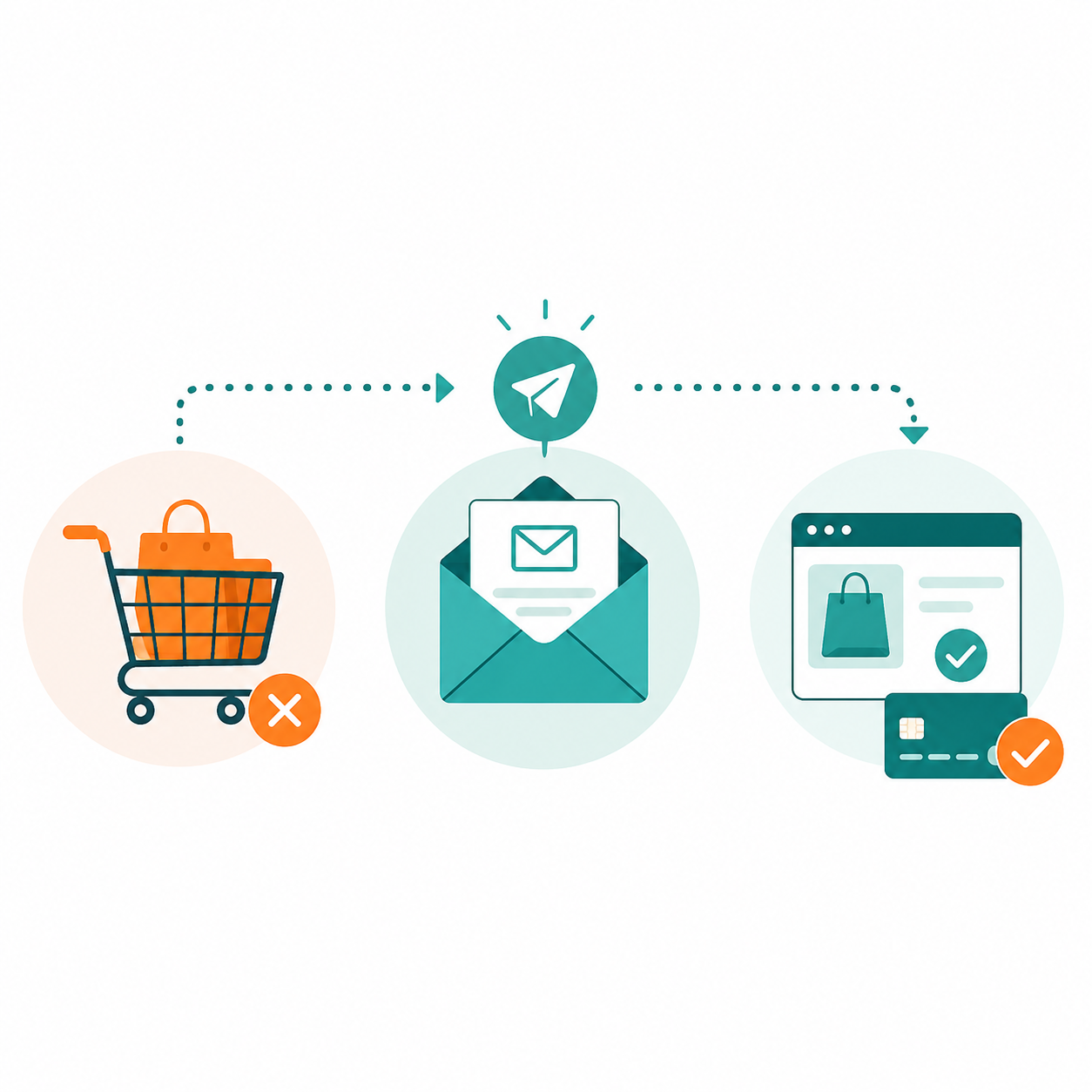

TL;DR: The most effective abandoned cart sequences use three emails: a gentle reminder within 1 hour, a social-proof or urgency-driven follow-up at 24 hours, and a discount-led final offer at 72 hours. Below are 12 real-world example structures you can adapt directly, plus the timing strategy and subject lines that drive the highest recovery rates.
Executive Summary
The average cart abandonment rate across ecommerce sits around 70% — meaning for every 10 people who add a product to their cart, roughly 7 leave without completing the purchase. Abandoned cart emails are one of the highest-ROI automations in ecommerce because they target people who already showed strong purchase intent.
This guide provides 12 example email structures across different stages of the abandonment sequence, along with the strategic reasoning behind timing, subject lines, and offer escalation.
Who This Guide Is For
- Ecommerce store owners setting up their first abandoned cart sequence
- Marketers looking to improve an existing sequence’s conversion rate
- Anyone using Klaviyo, Omnisend, or Mailchimp who needs copy inspiration
- Businesses wanting to reduce reliance on discounts in cart recovery
The Optimal Abandoned Cart Sequence Structure
Before the examples, understand the strategic logic behind a 3-email sequence:
| Timing | Goal | Tone | |
|---|---|---|---|
| Email 1 | 1 hour after abandonment | Gentle reminder, remove friction | Helpful, no pressure |
| Email 2 | 24 hours after abandonment | Build urgency, add social proof | Slightly more direct |
| Email 3 | 72 hours after abandonment | Final push, often with incentive | Direct, time-limited offer |
Why this timing works: Email 1 catches people who simply got distracted (forgotten tab, interrupted checkout). Email 2 addresses hesitation with trust signals. Email 3 targets price-sensitive holdouts who needed a final nudge.
Email 1 Examples: The Gentle Reminder (Send at 1 Hour)
Example 1: Simple and Direct
Subject: Did you forget something?
Body:
Hey [First Name],
Looks like you left [Product Name] in your cart. No rush — we saved it for you.
[Product image]
[Complete Your Order button]Questions about sizing or shipping? Just reply to this email.
Why it works: No pressure, no discount mentioned yet, frames the email as helpful rather than salesy.
Example 2: Highlighting What They’ll Miss
Subject: Your cart is waiting (and so is this color)
Body:
Hi [First Name],
We noticed you didn’t finish checking out. Your [Product Name] is still available, but popular items like this don’t always stay in stock.
[View Your Cart button]
We’re here if you have any questions before you complete your order.
Why it works: Introduces light scarcity without being aggressive, appropriate for the first touch.
Example 3: Visual-First Approach
Subject: Still thinking it over?
Body:
[Large product image]
[First Name], your cart is exactly how you left it.
[Complete Checkout button]
Free shipping on orders over $50 — you’re at $[cart total].
Why it works: Leads with the product visually and includes a relevant incentive (free shipping threshold) without a discount code.
Email 2 Examples: Urgency and Social Proof (Send at 24 Hours)
Example 4: Social Proof Driven
Subject: [Product Name] is selling fast
Body:
Hi [First Name],
[Product Name] has been added to carts 200+ times this week. Yours is still reserved, but we can’t guarantee it for long.
[Customer review snippet with star rating]
[Complete Your Order button]
Why it works: Uses social proof (popularity + reviews) to build confidence rather than relying solely on urgency.
Example 5: Addressing Common Objections
Subject: Still deciding? Here’s what others are saying
Body:
[First Name],
If you’re on the fence, here’s what real customers say about [Product Name]:
“[Genuine customer review quote]” — [Customer name], verified buyer
Free returns within 30 days if it’s not right for you.
[Complete Your Order button]
Why it works: Directly addresses purchase hesitation (fit, quality concerns) with reviews and a risk-reducing return policy.
Example 6: FAQ-Style Reassurance
Subject: Quick answers before you checkout
Body:
Hey [First Name],
A few things customers often ask about [Product Name]:
Shipping: 3-5 business days
Returns: 30-day free returns
Warranty: 1-year manufacturer warranty[Complete Your Order button]
Why it works: Removes logistical friction points that commonly stall checkout completion.
Example 7: Limited Stock Urgency
Subject: Only a few left in your size
Body:
[First Name], we wanted to give you a heads up —
Only [X] left in [size/variant] for [Product Name]. Your cart is saved, but stock isn’t guaranteed.
[Complete Your Order button]
Why it works: Genuine scarcity (when accurate) is one of the strongest conversion drivers at this stage — but only use this if stock data is real and accurate to avoid eroding trust.
Email 3 Examples: The Final Push (Send at 72 Hours)
Example 8: Modest Discount Offer
Subject: Here’s 10% off to complete your order
Body:
Hi [First Name],
We want to make this easy. Use code COMEBACK10 for 10% off your cart — valid for the next 24 hours.
[Complete Your Order with Discount button]
Why it works: A time-limited, modest discount converts price-sensitive holdouts without training your full list to wait for discounts on every purchase.
Example 9: Free Shipping as the Incentive
Subject: Free shipping, just for you
Body:
[First Name], your cart is still here — and we’re covering shipping if you complete your order in the next 48 hours.
[Complete Your Order button]
Why it works: Free shipping often converts as well as a discount while protecting product margin more effectively.
Example 10: Last Chance Framing
Subject: Last chance — your cart expires soon
Body:
[First Name],
This is the last reminder — your saved cart will be cleared in 24 hours.
[Product image]
[Complete Your Order button]If price is a concern, here’s 15% off: CART15
Why it works: Combines genuine urgency (cart expiration) with a meaningful final discount, appropriate as the last touch in the sequence.
Example 11: Personal, Founder-Style Tone
Subject: Can I ask why you didn’t complete your order?
Body:
Hi [First Name],
I noticed you didn’t finish checking out, and I wanted to personally reach out. If there’s something holding you back — price, shipping time, sizing — just reply and let me know.
If it’s price, here’s 10% off: WELCOME10
— [Founder/Team Member Name]
Why it works: A personal, conversational tone from a named individual (real or branded as the founder) often outperforms purely transactional copy at the final touch.
Example 12: Bundle/Upsell Final Offer
Subject: Complete your order + save on a bundle
Body:
[First Name], your cart is still saved. Complete your order now and add [complementary product] for 20% off.
[Complete Order + Add Bundle button]
Why it works: Rather than only discounting the original item, this increases average order value while still incentivizing completion.
Subject Line Performance Patterns
Based on aggregate ecommerce benchmark data, these subject line patterns consistently perform well across abandoned cart sequences:
| Pattern | Example | Why It Works |
|---|---|---|
| Direct question | “Did you forget something?” | Creates curiosity without being pushy |
| Personalization | “[First Name], your cart misses you” | Increases open rates measurably |
| Urgency (genuine) | “Only 3 left in your size” | Drives action when stock data is accurate |
| Incentive-led | “Here’s 10% off to finish your order” | Highest click-through on final email |
| Curiosity | “Quick question about your order” | Strong open rates, works well for email 2 |
Common Abandoned Cart Email Mistakes
- Leading with a discount in Email 1 — trains customers to always wait for a discount, eroding margin over time
- Sending all three emails on the same day — overwhelms the recipient and feels desperate rather than helpful
- Using fake urgency or stock counts — damages trust permanently if customers discover the scarcity claim was false
- Forgetting mobile optimization — the majority of abandoned cart emails are opened on mobile; test every template on a phone screen
- No clear single call-to-action — multiple competing buttons or links reduce click-through rates
Recommended Tools for Building These Sequences
Most major ecommerce email platforms support these sequences natively:
- Klaviyo — most advanced trigger and segmentation options for abandoned cart flows
- Omnisend — strong pre-built abandoned cart templates, easier setup for beginners
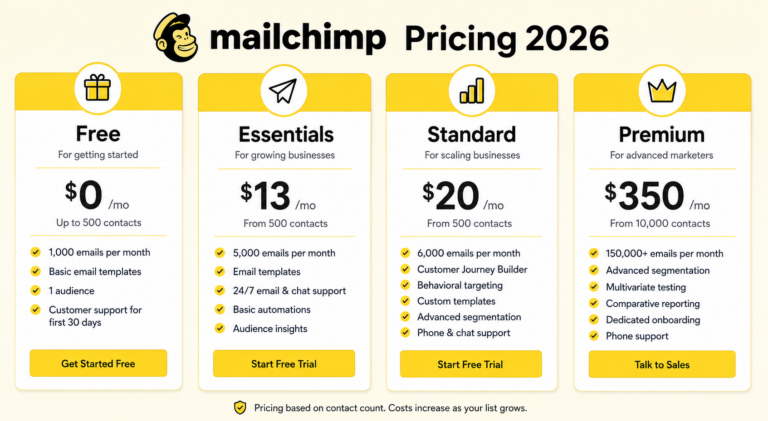
- Mailchimp — basic abandoned cart automation available, less granular than Klaviyo
(For platform comparison, see our Mailchimp vs Klaviyo guide.)
Frequently Asked Questions
How many abandoned cart emails should I send?
Three emails is the most commonly recommended structure, balancing recovery rate against the risk of feeling spammy. Some brands successfully run a 4-5 email sequence, but returns diminish significantly after email 3.
Should the first abandoned cart email include a discount?
Generally no. Save the discount for the second or third email — leading with a discount immediately trains your audience to always expect one, which erodes margin over time.
What’s a good cart recovery rate to aim for?
Well-optimized abandoned cart sequences typically recover 10-15% of abandoned carts, though this varies significantly by industry, price point, and audience.
How long should I wait before sending the first abandoned cart email?
One hour is the most commonly recommended timing — long enough to avoid feeling intrusive, short enough to catch the customer while purchase intent is still high.
Do abandoned cart emails work for B2B or only ecommerce?
They’re most effective for ecommerce, but similar logic applies to B2B abandoned form fills or incomplete trial signups, adapted with appropriate timing and tone for longer B2B sales cycles.
Should I use SMS in addition to email for cart recovery?
Many brands see additional recovery by adding SMS to the sequence, particularly for the urgency-driven second touch, though this requires separate opt-in consent for SMS marketing.
What if a customer completes their purchase mid-sequence?
All major platforms (Klaviyo, Omnisend, Mailchimp) automatically detect completed purchases and stop the remaining sequence emails — confirm this is configured correctly to avoid sending a discount offer after purchase.
Is it worth A/B testing abandoned cart emails?
Yes, even small changes (subject line, discount amount, send timing) can meaningfully impact recovery rate. Test one variable at a time and let each test run long enough to reach statistical significance.
Final Verdict
The strongest abandoned cart sequences follow a clear escalation: a helpful, no-pressure reminder first, social proof and urgency second, and a meaningful incentive only as the final push. Resist the temptation to lead with a discount — it costs you margin and trains customers to wait for one on every future purchase.
Use the 12 examples above as a starting structure, but always test against your own audience — tone, discount thresholds, and timing that work for one brand won’t necessarily replicate exactly for another.
Examples are illustrative templates intended for adaptation to your specific brand voice and product. Recovery rate benchmarks reflect general ecommerce industry trends as of mid-2026 and will vary by business.