
TL;DR: GDPR generally requires opt-in consent before collecting or processing personal data for marketing, while CCPA (and its successor, CPRA) is primarily opt-out based, focusing on the right to refuse data sale or sharing rather than requiring upfront consent. Marketers targeting both EU and California audiences need separate compliance approaches — satisfying one regulation does not automatically satisfy the other.
Executive Summary
GDPR and CCPA are often mentioned together as if they’re interchangeable privacy frameworks, but their underlying philosophy differs significantly. GDPR assumes personal data processing requires justification and consent from the outset. CCPA assumes data collection is generally permissible but gives consumers specific rights to control, access, and opt out of certain uses.
For marketers operating across both jurisdictions, understanding this fundamental difference is essential — a compliance approach built entirely around one framework will likely have gaps when applied to the other.
Who This Guide Is For
- Marketers running campaigns targeting both EU/UK and California audiences
- Businesses building a unified privacy compliance strategy across multiple jurisdictions
- Compliance teams evaluating whether existing GDPR processes satisfy CCPA requirements
- Companies expanding marketing operations into new geographic markets
Core Philosophy Difference
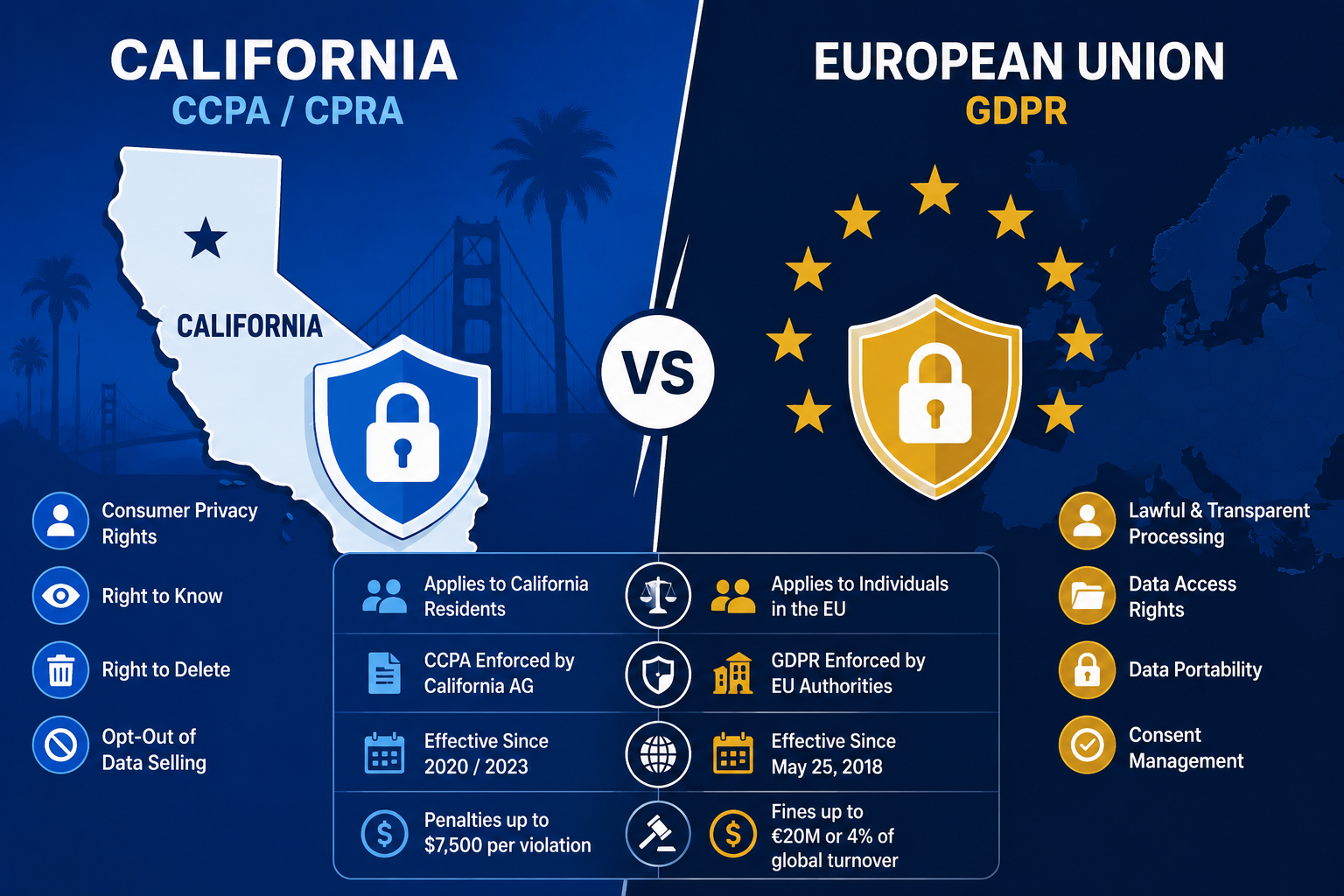
| Aspect | GDPR | CCPA/CPRA |
|---|---|---|
| Default approach | Opt-in required before processing | Opt-out available after collection |
| Legal basis required | Yes, must establish lawful basis (consent, legitimate interest, etc.) | No upfront legal basis requirement for collection itself |
| Primary consumer right | Right to control whether data is processed at all | Right to know, delete, and opt out of sale/sharing |
| Geographic scope | Anyone in the EU/UK, regardless of business location | California residents, with thresholds for which businesses are covered |
Consent and Opt-In Requirements
GDPR Approach
Before sending marketing emails or processing personal data for marketing purposes, you generally need explicit, informed, unambiguous consent. Pre-checked boxes are not valid consent. The default state must be “no marketing” until the individual actively opts in.
CCPA/CPRA Approach
There is no general requirement for opt-in consent before collecting personal information for marketing. Instead, businesses must provide notice at collection about what data is gathered and for what purpose, and honor opt-out requests for the sale or sharing of personal information specifically.
Key practical difference: Under GDPR, you cannot legally email someone for marketing purposes without their prior consent. Under CCPA, you can generally market to someone by default, but must honor their request to opt out of having their data sold or shared, and must respond to broader data rights requests (access, deletion).
Who Is Covered
GDPR Scope
Applies to any business processing personal data of individuals located in the EU or UK, regardless of where the business itself is headquartered or where the data processing occurs.
CCPA/CPRA Scope
Applies to businesses meeting specific thresholds: generally, businesses with gross annual revenue over $25 million, or those that buy/sell/share personal information of 100,000+ California consumers or households annually, or that derive 50%+ of annual revenue from selling personal information.
Practical implication: A small business marketing exclusively within the US might fall entirely outside CCPA’s scope if it doesn’t meet these thresholds, while GDPR’s scope is triggered simply by having any EU-based contacts, regardless of business size.
Consumer Rights Comparison
| Right | GDPR | CCPA/CPRA |
|---|---|---|
| Right to access their data | Yes | Yes |
| Right to deletion | Yes (“right to be forgotten”) | Yes |
| Right to opt out of data sale | Not the primary mechanism (consent-based instead) | Yes, core mechanism |
| Right to correct inaccurate data | Yes | Yes (added under CPRA) |
| Right to data portability | Yes | Limited |
| Right to non-discrimination for exercising rights | Implied | Explicit |
What “Sale” and “Sharing” Mean Under CCPA
This is a critical concept for marketers specifically, since much of digital marketing technology involves data sharing arrangements that may qualify as a “sale” or “sharing” under CCPA’s broad definitions — even without money changing hands.
Commonly triggers “sale/sharing” classification:
- Sharing customer data with ad networks for targeted advertising
- Using third-party tracking pixels that transmit visitor data to external platforms
- Providing customer lists to marketing partners for cross-promotion
Practical requirement: If your marketing technology stack involves any of these practices, you likely need a clear, accessible “Do Not Sell or Share My Personal Information” mechanism on your website, typically a dedicated link in your footer.
Building a Compliant Strategy for Both Regulations
Step 1: Implement Opt-In Consent as Your Baseline
Building your marketing consent process around GDPR’s stricter opt-in standard automatically satisfies CCPA’s lighter requirements, since opt-in consent exceeds what CCPA mandates. The reverse is not true.
Step 2: Add CCPA-Specific Mechanisms Regardless
Even with GDPR-level consent practices, you still need CCPA-specific features: a clear privacy policy disclosing data practices, a “Do Not Sell or Share” opt-out link if applicable, and a process for handling access/deletion requests from California residents specifically.
Step 3: Maintain Separate Documentation for Each Framework
Document your legal basis for processing under GDPR separately from your CCPA compliance measures, since regulators in each jurisdiction may request evidence specific to their own framework.
Step 4: Train Marketing Teams on Both Standards
Marketing staff building campaigns need to understand that audience segmentation by EU vs. California residency may require different consent and opt-out handling within the same campaign tool.
Common Compliance Mistakes
| Mistake | Risk |
|---|---|
| Assuming GDPR compliance automatically satisfies CCPA | Missing required opt-out mechanisms and disclosure requirements specific to CCPA |
| No “Do Not Sell or Share” link despite using ad tracking pixels | Direct CCPA violation if data sharing with ad networks qualifies as “sale/sharing” |
| Treating all US contacts the same regardless of state | Missing California-specific rights that don’t apply elsewhere in the US |
| Failing to honor opt-out requests promptly | Both frameworks require timely response, with specific deadlines varying by framework |
| No process for verifying requester identity before fulfilling deletion requests | Risk of fulfilling fraudulent deletion/access requests, exposing other customers’ data |
Penalties Comparison
| Framework | Maximum Penalty |
|---|---|
| GDPR | Up to €20 million or 4% of global annual revenue, whichever is higher |
| CCPA/CPRA | Up to $7,500 per intentional violation, $2,500 per unintentional violation (per California Privacy Protection Agency enforcement) |
Practical note: While GDPR’s maximum penalties are larger in absolute terms, CCPA violations are assessed per affected consumer record in many enforcement scenarios, meaning total exposure can still be substantial for businesses with large California consumer bases.
Frequently Asked Questions
If I’m GDPR compliant, am I automatically CCPA compliant too?
No. GDPR’s stricter consent requirements exceed what CCPA mandates for collection, but CCPA has specific requirements (opt-out mechanisms, specific disclosures) that GDPR compliance alone doesn’t address.
Does CCPA apply to all US businesses?
No, only businesses meeting specific revenue or data volume thresholds, and only regarding California residents specifically. Many small businesses fall outside CCPA’s scope entirely.
What counts as “selling” data under CCPA if I don’t literally sell customer lists?
CCPA’s definition is broad and includes many data sharing arrangements common in digital marketing, including ad network data sharing for targeted advertising, even without direct monetary exchange.
Do I need separate privacy policies for GDPR and CCPA?
Not necessarily separate policies, but your single privacy policy needs to address both frameworks’ specific disclosure requirements if you’re subject to both.
Is CPRA a replacement for CCPA, or an addition to it?
CPRA significantly amended and expanded CCPA, adding new rights (correction, limiting use of sensitive personal information) while building on CCPA’s foundational framework rather than replacing it entirely.
How do I know if my marketing technology qualifies as “sharing” data under CCPA?
Generally, if your tools transmit visitor or customer data to third parties for advertising or cross-context behavioral advertising purposes, this likely qualifies. Consult a privacy professional to assess your specific technology stack.
Can I use the same consent management platform for both GDPR and CCPA compliance?
Yes, most modern consent management platforms support both frameworks, though configuration differs since GDPR requires opt-in consent collection while CCPA primarily requires opt-out mechanism availability.
What’s the safest approach if I’m unsure which regulation applies to a specific contact?
Default to the stricter GDPR-style opt-in consent approach when uncertain, since this approach generally satisfies or exceeds CCPA’s lighter requirements, reducing overall compliance risk.
Final Verdict
GDPR and CCPA represent fundamentally different regulatory philosophies — opt-in consent versus opt-out rights — and marketers operating across both jurisdictions need distinct compliance mechanisms for each, not a single unified approach. Building your baseline marketing consent process around GDPR’s stricter standard provides a strong foundation, but CCPA-specific requirements like “Do Not Sell or Share” mechanisms and California-specific disclosure must still be implemented separately.
When in doubt about a specific contact’s applicable jurisdiction, defaulting to the stricter GDPR-style consent approach minimizes compliance risk across both frameworks simultaneously.
This guide provides general informational content and does not constitute legal advice. Privacy regulations are complex and continue to evolve — consult a qualified privacy attorney for guidance specific to your business and audience.